
For any small business, the jump to cloud computing boils down to three huge wins: serious cost savings, better profitability, and the freedom to grow without a massive upfront investment. It completely changes the game, turning your IT budget from a clunky, unpredictable capital expense into a smooth, predictable operating cost. This frees up your cash for what really matters—growing the business.
How Cloud Computing Reshapes Your Business Budget
Think of it like this: instead of buying an entire office building just to get a workspace, you sign a flexible lease. That's what the cloud does for your tech. You're shifting away from Capital Expenditures (CapEx), like buying bulky servers and expensive software licenses, to a simple Operational Expenditure (OpEx) model.
This isn't just accounting jargon; it's a strategic move. Rather than sinking thousands of dollars into hardware that will be a paperweight in a few years, you pay a manageable fee for exactly the resources you need, when you need them. That cash is now free to be pumped back into marketing, developing your next great product, or hiring that key employee you've been looking for.
The Power of Pay-As-You-Go
One of the best parts of the cloud is the 'pay-as-you-go' model. It completely eliminates the expensive guesswork of traditional IT. In the old days, you had to buy servers big enough to handle your absolute busiest day, which meant that hardware sat mostly idle—and wasted money—for the other 364 days of the year.
With the cloud, you only pay for what you actually use. Got a huge holiday sale coming up? You can instantly scale up your resources to handle the traffic spike, and just as easily scale back down when things quiet down. It ensures your IT spending is always perfectly in sync with your business needs.
The financial impact is real. By moving to this flexible model, small businesses sidestep all the hidden costs of on-premise IT, which directly boosts the bottom line and makes financial planning a whole lot easier.
Understanding the Total Cost of Ownership
To really see the savings, you have to look at the Total Cost of Ownership (TCO). An on-premise server isn't a one-time purchase. It comes with a long list of hidden—and ongoing—expenses:
- Hardware and Software: The big initial check you write for the servers, racks, and software licenses.
- Maintenance and Staffing: The salary for the IT folks needed to manage, update, and fix everything.
- Energy Bills: The surprisingly high cost of electricity to power and cool those servers 24/7.
- Physical Space: The rent or mortgage payment for the server room itself.
The table below breaks down this fundamental shift in spending. It highlights how moving from traditional infrastructure to the cloud changes not just how much you spend, but how you spend it.
On-Premise vs Cloud A Small Business Cost Comparison
| Cost Factor | On-Premise (CapEx) | Cloud Computing (OpEx) |
|---|---|---|
| Initial Investment | High (servers, software licenses, setup) | Low to None (no hardware purchase required) |
| Ongoing Costs | Unpredictable (maintenance, repairs, upgrades, electricity) | Predictable (monthly or annual subscription fee) |
| Staffing | Requires dedicated, in-house IT staff or expensive contractors | Managed by the cloud provider; reduces need for specialized staff |
| Scalability | Costly and slow (requires purchasing new hardware) | Instant and flexible (pay only for resources used) |
| Upgrades | Requires manual, disruptive, and costly hardware/software cycles | Automatic and included in the subscription |
| Energy & Space | Significant costs for power, cooling, and physical real estate | Zero direct costs; handled by the provider |
As you can see, cloud computing folds all those scattered expenses into one transparent fee. This leaner approach doesn't just cut your overall costs; it makes your budget incredibly simple. The positive ripple effects on profit and growth are well-documented.
This chart drives the point home, showing the direct impact cloud adoption has on key business numbers.
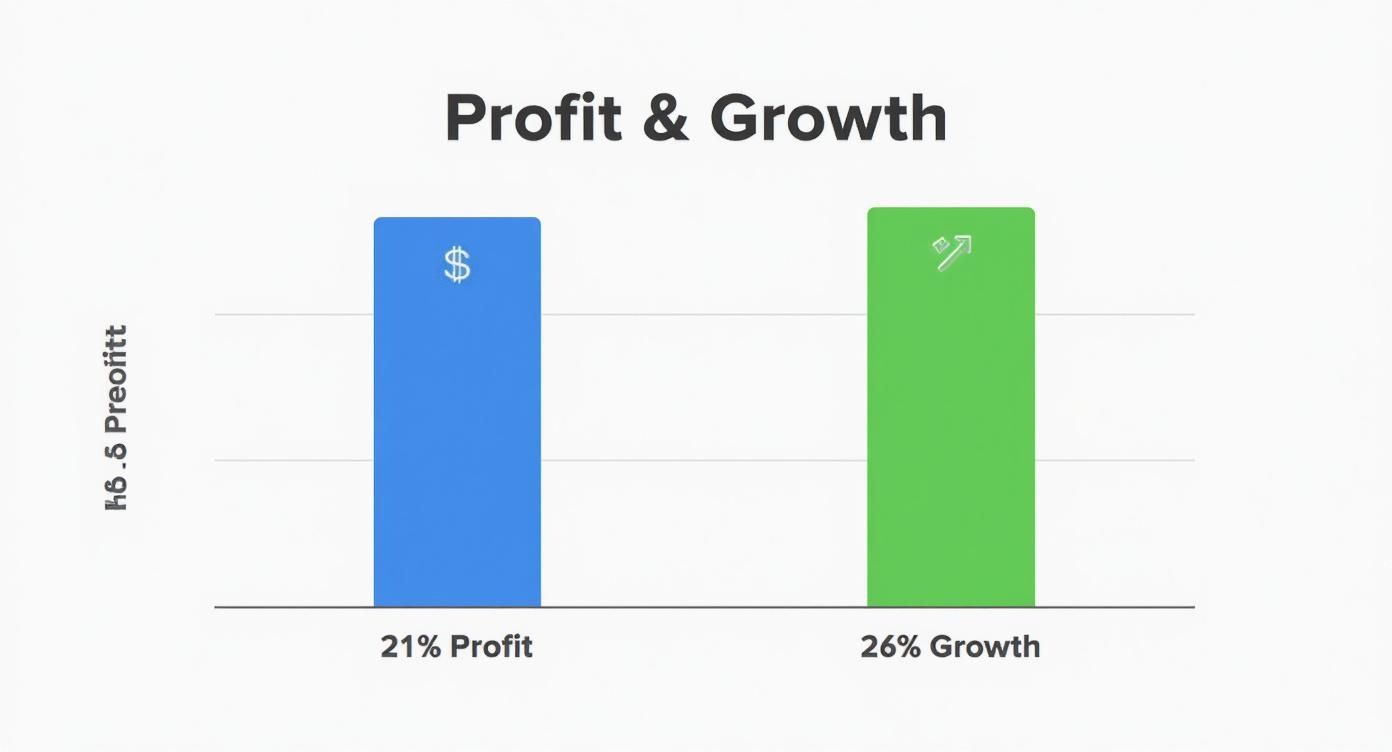
The data is clear: small and midsize businesses (SMBs) that embrace the cloud report, on average, 21% higher profits and 26% faster growth than their peers who don't. And for businesses that go all-in, moving over 60% of their work to the cloud, the boost is even bigger. You can discover more cloud computing statistics and their impact on SMBs to get the full story.
Ultimately, this financial efficiency is why moving to the cloud is no longer just an IT decision—it’s a core business strategy.
Scale on Your Terms and Move Faster

Think about your website during your busiest season. If you’re running your own server in a closet somewhere, a sudden flood of visitors could bring everything crashing down. The only way to prevent that is to buy way more hardware than you need for the other 11 months of the year, which is a massive waste of money.
This is exactly the problem the cloud was built to solve. The core idea is scalability, or what many in the industry call "elasticity." It's the ability to dial your IT resources up or down in minutes, not months.
This means when your big marketing campaign takes off, you can instantly add more server power to keep things running smoothly. When the traffic dies down, you can dial it right back. You only ever pay for what you actually use, turning a potential disaster into a flawless customer experience.
Stop Reacting and Start Innovating
This on-demand power gives your business a level of agility that just wasn't possible before. In the old days, testing a new app or service was a huge undertaking. You had to order servers, wait for them to arrive, and spend weeks setting them up—all for an idea that might not even pan out.
With the cloud, that entire process is squashed down to a few clicks. You can spin up a new virtual server in minutes to test a new product, see how it performs, and make a quick, informed decision. If it’s a dud, you just turn it off. The financial risk is tiny.
This shift in speed fundamentally changes how you operate. You go from a slow, reactive company to one that can innovate on the fly. It dramatically lowers the barrier to experimentation, letting you test new ideas and respond to the market faster than your competitors.
This kind of agility is more than just a convenience; it's a serious competitive edge. Companies that embrace the cloud often grow faster because they can jump on new opportunities without being bogged down by their physical hardware. They can pivot, adapt, and build at a pace that used to be reserved for tech giants.
- Handle Seasonal Peaks: Easily manage Black Friday traffic or a promotional rush without your site slowing to a crawl.
- Support Real Growth: As your company grows, your IT infrastructure grows right alongside you, no disruptive hardware overhauls needed.
- Eliminate Waste: Stop paying for servers to sit idle during your slow months and put that budget to better use.
Ultimately, the cloud gives you a flexible foundation to do more than just survive—it helps you thrive. It gives you the power to handle unexpected success without skipping a beat and the freedom to try the new ideas that will fuel your growth for years to come.
Fortifying Your Business with Enterprise-Grade Security

It’s a common concern for small business owners: does moving to the cloud open you up to more security risks? The reality is actually the complete opposite.
Think of it this way. Keeping your data on a server in your office is like stashing your life savings under the mattress. It’s close by, but a single break-in could be catastrophic. Moving to a major cloud provider is like depositing that money in a Fort Knox-style bank vault, complete with armed guards and 24/7 surveillance.
Big players like Amazon Web Services (AWS) and Microsoft Azure invest billions into security every single year—an amount no small business could ever dream of matching. They have armies of the world's best cybersecurity experts working around the clock, which is a level of protection that goes far beyond what a small in-house IT team can provide.
For any business owner who wants to sleep better at night, this alone is one of the most compelling arguments for the cloud.
Automated Defenses and AI-Powered Threat Detection
A huge piece of that security puzzle is automation. Cloud platforms take care of the relentless, thankless job of patching security holes and updating systems for you. This simple act eliminates a massive risk factor: human error. No more forgetting a critical update or pushing it off until next week.
On top of that, these platforms are constantly watching your back. They use incredibly smart AI and machine learning to scan for unusual activity 24/7, spotting and stopping potential threats before they can do any real damage. It’s a proactive shield, not just a reactive cleanup crew.
This shift to a stronger defense isn't just a theory. In fact, roughly 94% of businesses say they saw a security improvement after moving to the cloud, all thanks to these advanced, built-in protections. You can read more about the impact of cloud adoption on SMBs to get the full picture.
Simplifying Compliance and Reducing Risk
If you handle sensitive data, you know the headache of trying to meet compliance standards like HIPAA or GDPR. The rules are complex, the paperwork is endless, and the fines for getting it wrong can be crippling.
This is another area where the cloud is a game-changer. Cloud providers build their platforms with these regulations in mind, giving you the tools and certified environments you need to tick all the right boxes.
They go through intense third-party audits and hand you the documentation to prove your own compliance, which dramatically cuts down on your administrative workload and legal risk. Managing these rules is a vital part of cybersecurity for growing businesses, and the cloud makes it infinitely easier.
By letting a dedicated provider handle the heavy lifting on security and compliance, you’re free to put your energy and budget where they belong: running your company with confidence.
Building Resilience with Superior Data Protection
For any small business, your data isn't just a collection of files. It’s the lifeblood of your company—it’s your customer list, your financial records, and your unique competitive advantage. What would happen if you lost it all to a server crash, an office fire, or a crippling ransomware attack? It’s a terrifying thought, and relying on old-school backups like external hard drives is a gamble you can’t afford to take.
This is where the cloud truly shines, offering a level of data protection that was once out of reach for most small businesses. Think of it as an automated, off-site vault for your most critical asset. Instead of keeping your only backup copy in the same building that could get flooded, cloud services automatically copy your data to multiple, geographically separate, and incredibly secure data centers.
From Weeks of Downtime to Hours of Recovery
Let's play out a scenario: a burst pipe floods your office, making it completely inaccessible. With your backups on a server in the closet, you'd be looking at days, maybe even weeks, of downtime. You'd have to find new hardware, install everything from scratch, and hope the data restoration works.
With a cloud-based disaster recovery plan, the story is completely different. You could have your entire team back up and running from a new location in a matter of hours.
This incredible speed is measured by two key metrics:
- Recovery Time Objective (RTO): How long can your business realistically be down before it starts to hurt? The cloud can shrink this recovery window from weeks to just a few hours.
- Recovery Point Objective (RPO): How much data can you afford to lose? With frequent, automated cloud backups, you might only lose a few seconds of work instead of an entire day's worth.
By dramatically improving both your RTO and RPO, the cloud turns disaster recovery from a chaotic, high-stakes emergency into a calm, predictable process. It’s about protecting your revenue and, just as importantly, your customers' trust.
A Proactive Approach to Data Safety
Of course, great data protection doesn't just happen. While cloud platforms provide the foundation, it's still crucial to follow Best Practices For Protecting Your Data In The Cloud.
This means making sure your backups are configured correctly, carefully managing who has access to what, and understanding your role in the security equation. Working with a managed IT provider gives you an expert in your corner to ensure everything is set up perfectly for your business, adding a vital layer of oversight. This proactive approach makes sure your business continuity plan is more than just a document—it's a tested, reliable safety net.
5. Unlock True Teamwork and Remote Flexibility
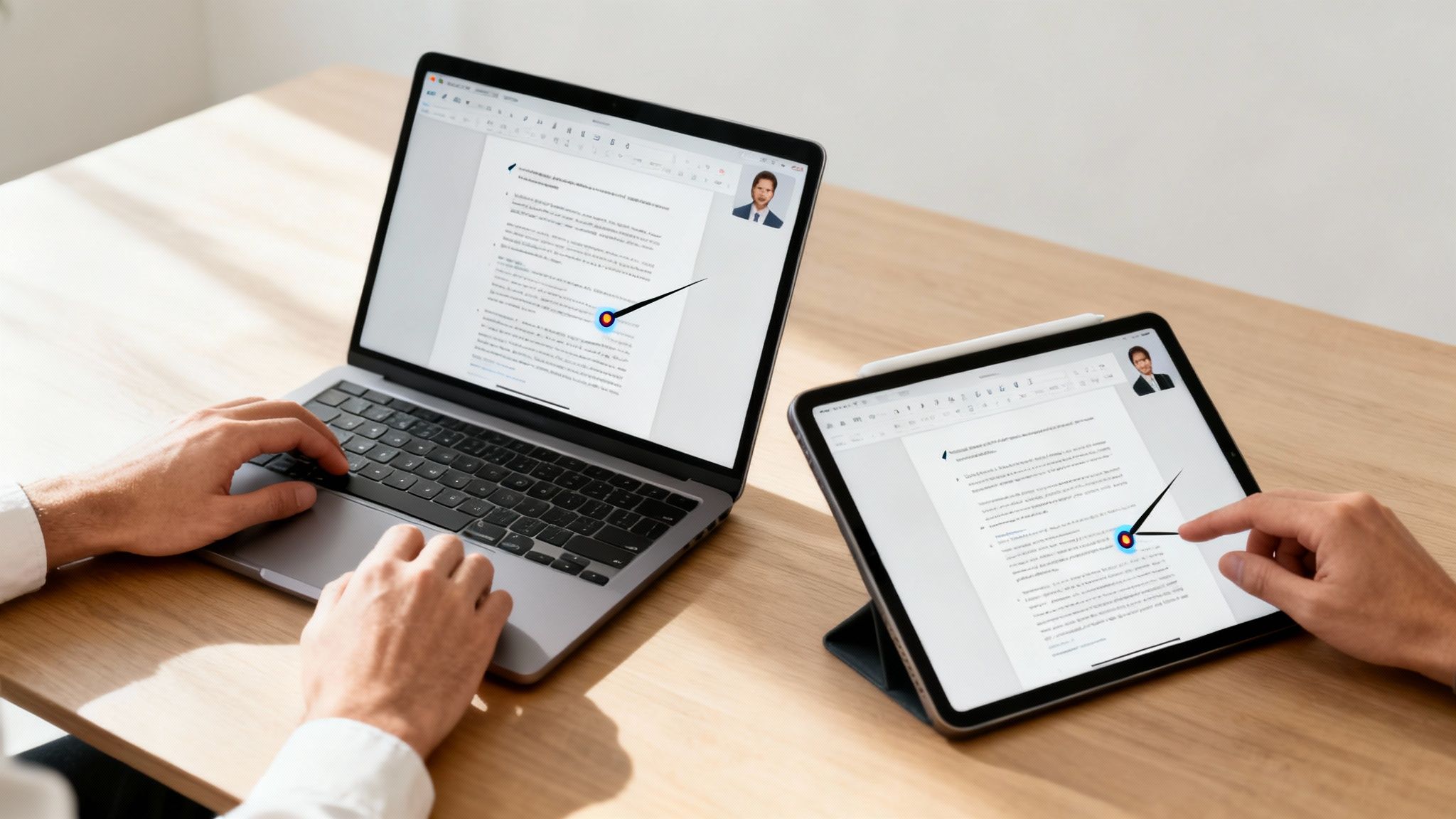
In a world where your team might be scattered across town or across the country, the cloud acts as your central hub. It’s the digital headquarters where work actually gets done, moving you beyond the clunky, inefficient days of endless email attachments and version control nightmares.
This is about more than just convenience; it’s about erasing physical boundaries. Think about it: with tools like Microsoft 365 or Google Workspace, your team can dive into the same document from anywhere. A sales proposal gets updated by someone in the office, reviewed by a manager at the airport, and tweaked by a consultant at their home desk—all at the same time.
Finally, a Single Source of Truth
We’ve all been there, trying to find the real final version of a file. Was it "final_v3_draft_FINAL.docx" or "final_v4_definitely_final.docx"? Cloud collaboration puts an end to that chaos for good.
When your files live in one central, secure place, everyone is on the same page, always working with the latest information. This simple shift drastically cuts down on errors, streamlines project workflows, and ensures your team is pulling in the same direction, no matter where they clock in.
This isn't just about making life easier. It's a genuine strategic advantage. When you can offer a secure, flexible work environment, you suddenly have access to a global talent pool. You can improve work-life balance for your current team and build a business that isn’t dependent on a single physical location.
Make Remote Work Actually Work
The ability to work from anywhere isn't a perk anymore; it's an expectation for a huge part of the workforce. The cloud provides the secure, reliable foundation you need to build a successful and sustainable remote or hybrid work model.
This kind of operational agility is a game-changer. In fact, 13% of small businesses point to better remote work capabilities and seamless collaboration as a top benefit of moving to the cloud. These platforms give your team full access to their tools from any device, anywhere they have an internet connection. You can find more details on these trends in this report on SMB cloud adoption from CloudTech.
By embracing these tools, you're empowering your people to connect, communicate, and create more effectively. The result is a more engaged, productive team that can thrive no matter what the world throws at it.
Making a Smart and Seamless Transition to the Cloud
The benefits of cloud computing are clear, but the idea of actually moving your entire business can feel pretty overwhelming. It's a big step. The good news is you don't have to figure it all out on your own. This is where partnering with a Managed Service Provider (MSP) makes all the difference.
Think of an MSP as your expert guide for the journey. They've walked this path countless times and know all the potential pitfalls. They bring the map, the tools, and the experience to get you there safely, letting you focus on your business instead of getting tangled up in a complex IT project.
With an expert team managing the process, a cloud migration is far less disruptive than most people think. It's a carefully planned operation designed to protect your data and keep your team working without missing a beat.
What an IT Partner Manages for You
A seasoned MSP takes the entire migration process off your plate, from start to finish. They handle the technical details so you don't have to. Here’s what that typically looks like:
- Initial Assessment: First, they’ll do a deep dive into your current IT environment. They'll look at your hardware, your software, and how your team actually uses it all day-to-day.
- Strategic Planning: Based on that assessment, they build a custom migration plan just for you. This roadmap lays out the move in logical phases, prioritizing what’s most important to minimize any downtime.
- Execution and Management: This is the heavy lifting. The MSP handles the actual process of moving your data and applications to the cloud, often scheduling the big moves after hours so your business operations aren’t affected.
- Ongoing Optimization: The partnership doesn’t end once you're in the cloud. They continue to manage, secure, and fine-tune your new environment to make sure you're always getting the best performance and value.
To get a better sense of what this support looks like long-term, you can explore the full range of professional managed IT services that make it all work.
This isn't just a niche trend; it's quickly becoming the standard for small and mid-sized businesses. In fact, 63% of SMB workloads globally are now running on public cloud platforms. You can dig into more stats about this growing reliance on cloud infrastructure. Working with an expert from day one ensures your business makes the move the right way.
Frequently Asked Questions About the Cloud
Even with all the clear advantages, it's smart to have questions before making a big switch. Let's tackle some of the most common concerns we hear from small business owners about moving their operations to the cloud.
Is the Cloud Really Secure Enough for My Data?
Absolutely. It’s a common misconception that keeping data on-site is safer, but in reality, your data is often far more secure in the cloud. Think about it: top-tier providers like Microsoft Azure and AWS invest billions of dollars into security measures that are simply out of reach for most small businesses.
They employ elite cybersecurity teams, use advanced AI to hunt for threats 24/7, and protect their physical data centers with extreme measures. While no system is ever 100% foolproof, partnering with a major cloud provider and a skilled IT team to configure everything correctly is a massive security upgrade.
For a deeper dive into all the ways the cloud can help, you can learn more about how the cloud can benefit your business.
What Happens If Our Office Internet Goes Down?
This is a fair question, but one with a surprisingly simple answer. Many modern cloud applications are built with offline modes. This means your team can keep working on documents and files, and the moment the connection comes back, everything syncs up automatically.
For businesses that can't afford any downtime, the solution is a backup internet connection, like a 4G/5G cellular failover. This secondary link kicks in the instant your main line drops, keeping you online without a hitch. Honestly, the risk of a brief internet outage is much smaller and easier to manage than the risk of a local server crashing, which could take your business down for days.
You can learn more about how we build this kind of resilience by reading about our approach to client partnerships.
Will Moving to the Cloud Disrupt Our Business?
With a well-managed migration, the goal is always minimal disruption. A good IT partner won't just flip a switch overnight. The process is almost always handled in phases, starting with less critical systems to work out any kinks before touching your core operations.
An experienced IT partner builds a detailed migration plan from the ground up. The heavy lifting—like massive data transfers—is scheduled for nights or weekends. Then, they test everything thoroughly before the final cutover to make sure it all works perfectly from day one.
This careful, deliberate planning ensures the transition feels smooth and seamless for your employees and, most importantly, your customers.
Ready to unlock these benefits for your business with a trusted, veteran-owned partner? The team at Defend IT Services is here to build a secure, scalable cloud strategy that fits your unique needs. https://defenditservices.com