



You've heard the term "penetration testing"—often shortened to "pen testing"—but what does it actually mean for your business? In short, it’s a simulated cyberattack on your own systems, performed by professionals to find security holes before the real bad guys do.
Think of it as hiring a team of ethical hackers. Their job is to probe, poke, and test your defenses to uncover any exploitable weaknesses.
What is Penetration Testing? A Fortress Analogy
Let's imagine your business is a fortress. Inside, you store your most valuable treasures: customer data, financial records, and all your hard-earned intellectual property. You've done the basics, like building high walls (your firewalls) and posting guards at the gates (your antivirus software). But are you truly secure?

A penetration test is like hiring a special operations team to try and breach your fortress. They aren't there to steal anything. Instead, their mission is to find every weak point you might have missed.
- Is there a weak spot in the wall? (An unpatched software vulnerability).
- Can someone sneak through an unguarded service tunnel? (An unsecured internal network).
- Have the guards become complacent and predictable? (A weak password policy).
Once their mission is complete, they hand you a detailed report of their findings. This isn’t just a technical checklist; it’s a real-world assessment of your security. It moves beyond theory to show you exactly how an attacker could get in, helping you shore up your defenses where it counts.
If you want to dig deeper into the nuts and bolts, this comprehensive guide on what is penetration testing is a great resource.
The Core Components of a Test
To better understand the process, let's break down the key elements of a penetration test using our fortress analogy.
Penetration Testing at a Glance
| Component | Description | Analogy (The Fortress) |
|---|---|---|
| Scope | The specific systems, applications, or networks that will be tested. | Defining the fortress's perimeter—the main castle, the outer walls, and the supply routes. |
| Methodology | The approach used for the test, like black-box, white-box, or grey-box testing. | Deciding if the attack team has blueprints (white-box) or knows nothing (black-box). |
| Vulnerability Scanning | Automated tools are used to identify known vulnerabilities. | A quick aerial survey to spot obvious weaknesses like broken windows or unlocked doors. |
| Manual Exploitation | Ethical hackers manually attempt to exploit identified vulnerabilities. | The special ops team actively tries to pick locks, climb walls, or bypass guards. |
| Reporting | A detailed report outlining vulnerabilities, risks, and recommended fixes. | The team's debrief, showing you exactly how they got in and how to seal those entry points. |
Each component plays a crucial role, moving from a broad overview to a hands-on, practical assessment of your security.
Why Proactive Security Is No Longer Optional
This kind of proactive security isn't just a "nice-to-have" anymore; it's a must. As cyber threats become more sophisticated, businesses are under increasing pressure to validate their defenses.
The market reflects this reality. The global penetration testing market was valued at around USD 2.45 billion in 2024 and is expected to climb to USD 6.25 billion by 2033. This surge is driven by two things: a sharp rise in cyberattacks and the growing list of regulations like GDPR, HIPAA, and PCI DSS that demand rigorous security assessments.
At its core, penetration testing answers one simple but vital question: "How would our security hold up against a determined, skilled attacker?" The answer provides a clear roadmap for improvement.
By simulating an attack, you gain priceless insight into how a real one could unfold. It gives you the chance to close the gaps and protect your most critical assets before it's too late.
The Three Main Approaches to Pen Testing
Penetration tests aren't a one-size-fits-all solution. The real value comes from simulating different kinds of real-world attacks, and that all boils down to one key question: how much information do you give the security team upfront?
Think of it like hiring someone to test the security of your office building. Do you give them a map, the master keys, or just the street address and tell them to have at it? Each approach gives you a completely different perspective on your defenses. Let’s walk through the three main methodologies: Black Box, White Box, and Grey Box.
Black Box Testing
Imagine you’ve hired a team to test your building's security, but you give them zero information. No blueprints, no employee list, not even a hint about the side entrance. That's the essence of a Black Box test.
In this scenario, the ethical hackers have no prior knowledge of your internal systems. They start from the outside, just like a real attacker would, relying on publicly available data to find a crack in your defenses. It’s the perfect way to see how a determined outsider might target your website, servers, or other public-facing assets.
Black Box testing gives you a raw, authentic look at your security from an external attacker's point of view. It answers the critical question: "What could a stranger find and exploit with what's publicly available?"
Because the testers are starting from square one, this method can take more time to uncover issues buried deep inside your network. But for testing your perimeter security, it's invaluable.
White Box Testing
Now, let's flip the script. This time, you hand the security team the complete architectural plans, all the keycards, and even the alarm codes. They know every hidden camera, every weak point in the walls, and the entire security staff's patrol schedule. This is White Box testing.
With this approach, testers get full access to everything—source code, network maps, administrator passwords, you name it. This "all-access pass" lets them conduct a incredibly deep and efficient analysis of your systems from the inside.
A White Box test is fantastic for simulating an insider threat. What could a disgruntled employee with high-level access do? Or what happens if a hacker steals an administrator's credentials? It's the most exhaustive method, leaving no stone unturned across your entire infrastructure.
Grey Box Testing
Of course, there’s a middle ground. What if you give the security team a standard employee keycard and a basic visitor's map? They have some limited knowledge and access, but they don't have the keys to the kingdom. This is Grey Box testing.
This is probably the most popular and practical approach for many businesses. You give the ethical hackers some information, like a standard user's login credentials. Their mission is to see how far they can get from that starting point, trying to escalate their privileges to gain more access. It simulates what would happen if an attacker successfully phished one of your employees.
Grey Box testing strikes a powerful balance between the other two methods:
- It's far more efficient and can go deeper than a pure Black Box test.
- It provides a more realistic simulation of many common attack scenarios than a full White Box test.
This balanced approach often delivers the most bang for your buck, giving you a clear picture of your most likely risks without the longer timeline of a pure Black Box engagement.
A Look Inside a Professional Pen Test
Ever wonder what a professional penetration test actually involves? It’s far from the chaotic, spur-of-the-moment hacking you see in movies. Instead, it’s a highly structured and methodical mission, broken down into clear, distinct phases.
Think of the pen testing team as a group of architects and engineers brought in to stress-test a new bank vault. They don't just start swinging sledgehammers. They study the blueprints, probe for weak spots in the walls, and then try to exploit them with precision. Every step is deliberate, designed to give you a clear, actionable picture of your security.
This disciplined approach is what makes a professional assessment so valuable. It ensures every potential weakness is found, tested, and documented, moving from quiet observation to active attack and, finally, a strategic debrief.
Phase 1: Reconnaissance
This first step is all about gathering intelligence. The ethical hacking team acts like a detective, collecting any publicly available information about your company without touching your systems directly. It’s a passive, information-gathering stage.
What are they looking for? Things like:
- Employee names and email address patterns found online.
- The types of technology you use, often mentioned in job postings.
- Public network information and details about your company's domains.
This reconnaissance phase helps the team build a map of your digital footprint. It outlines potential targets and helps them form an initial attack plan based on information a real-world attacker could easily find.
Phase 2: Scanning and Discovery
With a map in hand, the team moves from passive observation to active probing. This is the scanning phase. Using a suite of specialized tools, they start knocking on your digital doors to see who answers and how.
The goal here is to find open ports, identify running services, and uncover potential vulnerabilities in your network or applications. This process turns the broad map from reconnaissance into a detailed blueprint, highlighting specific software versions that might be out-of-date or misconfigured. These are the potential entry points.
The infographic below shows how the amount of information a tester starts with—from zero knowledge (Black Box) to full access (White Box)—shapes these initial phases.
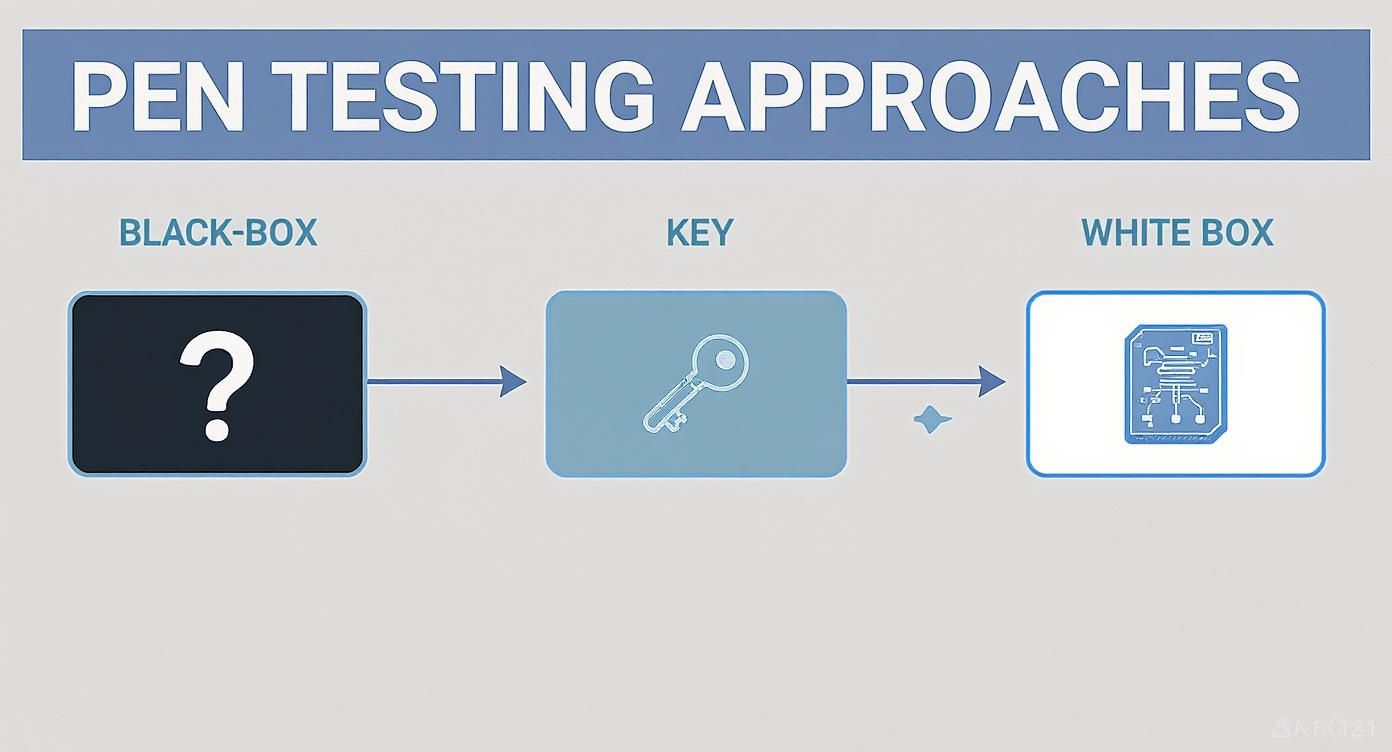
As you can see, the more knowledge the tester has upfront, the more targeted the scanning and discovery process can be.
Phase 3: Gaining and Maintaining Access
This is where the action happens. During the gaining access phase, the ethical hackers attempt to exploit the vulnerabilities they found during scanning. It’s time to see if those theoretical weaknesses can actually be broken. This could mean using a known software exploit, cracking a weak password, or tricking an employee with a simulated phishing attack.
But getting in is only half the battle. Next, they focus on maintaining access. The tester will try to secure their foothold in the system, often by elevating their privileges to gain more control, just like a real attacker would. This crucial step demonstrates the true potential damage of a breach—showing how an intruder could move through your network to steal sensitive data, all while staying hidden.
The real goal here is to demonstrate business impact. It’s not enough to say a door is unlocked. The test shows what a thief could actually steal once they walk through it.
Phase 4: Analysis and Reporting
The final phase is arguably the most important: analysis and reporting. Once the hands-on testing is done, the team translates all their technical findings into a clear, comprehensive report. This isn't just a jumble of code and jargon; it's a strategic document built for business leaders.
A good report explains each vulnerability, assesses its risk to your business, and provides concrete, actionable steps for you to fix it. It will even prioritize the fixes, telling your IT team which fires to put out first.
This is what turns a technical exercise into a powerful tool for improving your overall security. Understanding where you're vulnerable is the first step, and these kinds of assessments fit perfectly within a broader strategy of ongoing managed services designed to keep your business protected.
Comparing Internal and External Pen Tests
Security threats aren't always a case of someone trying to break down your front door. While most businesses rightly focus on fending off attacks from the outside world, a surprising number of real dangers can start from within. To build a defense that actually works, you need to test it from both angles: external and internal.

An external penetration test is exactly what it sounds like. It mimics an attack from a complete outsider somewhere on the internet. Imagine a burglar casing your building from the street—they're checking the locks on your doors, looking for unlocked windows, and testing the security gates. The ethical hacker has zero special access and is trying to find a way in through your public-facing systems, like your website or email servers.
On the other hand, an internal penetration test starts with a much scarier premise: the attacker is already inside. This could be a disgruntled employee, a contractor with temporary network access, or an attacker who successfully phished a username and password. Their goal is to see how much chaos they can cause once they're past the initial defenses.
The Attacker's Point of View
The biggest difference boils down to the attacker's starting line and what they're looking for.
- An external test is all about probing your perimeter for weaknesses that are visible from anywhere in the world.
- An internal test digs into what happens after a breach, checking for things like weak access controls or outdated software that could let an intruder move freely through your network.
To really understand how these two approaches differ, let's break them down side-by-side.
Comparing Internal vs External Penetration Tests
| Attribute | External Penetration Test | Internal Penetration Test |
|---|---|---|
| Attacker's Position | Outside the network (the internet) | Inside the network (e.g., connected to office Wi-Fi) |
| Assumed Knowledge | None. Simulates an unknown attacker. | Varies. Can simulate a guest, a standard user, or a privileged user. |
| Primary Goal | Breach the network perimeter. | Move laterally, escalate privileges, and access sensitive data. |
| Typical Targets | Websites, firewalls, VPNs, email servers. | Internal servers, databases, workstations, file shares. |
| Key Question | "Can a stranger get into our systems from the outside?" | "What's the worst that could happen if an attacker gets inside?" |
Seeing them laid out like this makes it clear: a solid security strategy absolutely needs both. One protects your perimeter, and the other secures everything behind it. Skipping one leaves a massive blind spot that attackers are more than happy to exploit.
By testing from both perspectives, you get a complete picture of your security posture. It answers not only "Can someone get in?" but also "What could they do if they did?"
Why Insider Threats Are Getting More Attention
For a long time, the focus was almost entirely on stopping external threats. But that thinking is changing as businesses wake up to the damage an insider can cause. The market numbers tell the story. The external pen testing market was valued at a hefty $2.9 billion in 2020 and continues to grow.
But look at the internal testing market—it's exploding, with a projected compound annual growth rate of 26.4%. This surge shows a growing understanding that insider risks are a huge problem. You can dig into more penetration testing statistics and trends to see just how quickly the industry is shifting.
Ultimately, choosing between an internal and external test isn't an "either/or" decision. The real question is which one you need to prioritize right now based on your specific risks. The long-term goal should always be to build both into your regular security routine.
The Business Case for Penetration Testing
Thinking about penetration testing as just another IT expense is a mistake. It’s not about ticking a box; it's a strategic investment in your company’s survival. A professional pen test goes way beyond just finding a few software bugs. It directly protects your revenue, your reputation, and the hard-won trust you’ve built with your customers. It’s the difference between waiting for a disaster and actively preventing one.
One of the most compelling reasons to invest is meeting regulatory compliance. If your business operates in certain industries, this isn't optional—it's the law.
- PCI DSS is a must if you handle credit card information.
- HIPAA is the standard for anyone in the healthcare space.
- GDPR applies if you manage data for any EU citizens.
Getting this wrong can lead to staggering fines, legal battles, and even losing the right to operate. Regular penetration testing gives you documented proof that you’re taking security seriously, which is exactly what auditors want to see.
Prioritizing Security Spending and Building Trust
A professional pen test also serves as a crystal-clear roadmap for your security budget. Instead of throwing money at problems you think you have, you get a prioritized list of real, exploitable vulnerabilities. This lets you be smart with your resources, tackling the most dangerous issues first and making sure every dollar is spent where it counts. It answers the critical question: "Where are we most exposed?"
This commitment to security sends a powerful message. We all know how common data breaches are, so when you can show that you're actively testing your own defenses, it builds incredible trust with customers, partners, and investors.
Proving your systems are secure is no longer a technical detail—it's a core part of your brand promise. This proactive approach shows you are a reliable steward of the sensitive data entrusted to you.
An Essential Practice for Businesses of All Sizes
While certain industries have been doing this for years, the need for solid testing has gone mainstream. Historically, Banking, Financial Services, and Insurance (BFSI) have led the way, mainly because they’re prime targets for financial fraud and face heavy compliance pressures. You might see more about these trends in penetration testing adoption reports.
While big corporations once dominated this space, penetration testing is now absolutely essential for small and medium-sized businesses, which are often seen as easier targets by attackers.
Ultimately, understanding the importance of cybersecurity for growing businesses comes down to one simple truth: a single breach can cause catastrophic financial and reputational damage. Penetration testing is one of the single most effective ways to stop that from happening.
How to Conduct Your First Pen Test
Diving into your first penetration test can feel a bit daunting, but it doesn't have to be. Think of it less as a huge, complex project and more as a series of well-defined steps. With a bit of planning and clear communication, you can move from feeling uncertain to having a structured assessment that gives you real, valuable insights.
The whole journey starts with a simple, non-technical question: what are we actually testing? This initial step, called scoping, is the bedrock of a successful test. It keeps the effort focused on what matters most and prevents the test from spiraling out of control.
Define the Scope of the Test
First things first, you need to draw a clear line in the sand. Decide precisely what’s "in" for the test and, just as importantly, what’s "out." Are you trying to find weaknesses in your brand-new e-commerce website? Or is the focus on your internal network where all your employee data lives? Maybe it's your cloud setup you're worried about.
A well-defined scope prevents testers from wasting time on irrelevant systems and avoids accidentally disrupting critical business operations.
To nail down your scope, ask yourself a few key questions:
- Which systems are we testing? Get specific. List out the exact IP address ranges, URLs, or application names.
- What’s our biggest fear? Are you trying to stop a data breach of customer credit card numbers, or is your main concern preventing ransomware from taking your business offline?
- When can the testing happen? Some aggressive tests are best run overnight or on a weekend to avoid slowing things down for your customers or employees.
Getting these boundaries down on paper is easily the most important part of the planning phase. It ensures the final report you get is filled with findings that actually matter to your business.
By setting firm boundaries from the start, you control the engagement's cost, timeline, and focus, ensuring the penetration test directly addresses your most pressing security questions.
Choose Your Testing Partner
With your scope defined, it's time to decide who will actually do the hacking. You really have two paths: build an internal team to do it or hire an outside firm of ethical hackers. While your own IT team knows your systems inside and out, an external partner brings a crucial advantage—a fresh pair of eyes. They see your company just like a real-world attacker would, without any internal biases or assumptions.
If you go with a third-party vendor, you need to vet them carefully. Ask some direct questions to make sure they’re the right fit:
- What certifications do your testers have? You want to see credentials like OSCP (Offensive Security Certified Professional), GPEN, or CREST. These show a verified level of skill.
- Can you share a sanitized sample report? This is your best window into what you'll actually receive. Is it clear, concise, and actionable, or a jumble of technical jargon?
- How will you protect our data during the test? They will likely find sensitive information. You need to be confident they have a rock-solid process for handling it securely.
Establish the Rules of Engagement
Once you’ve picked your partner, the next step is to create the rules of engagement. This is a formal document that acts as the playbook for the entire test. It lays out every single detail: the scope you already defined, the exact testing timeline, who to call in an emergency, and—crucially—any actions that are strictly off-limits.
Think of this document as a safety net for both you and the testing team. It makes sure everyone is on the same page about the goals and limitations, which is essential for a smooth and productive test. It’s also a good idea to give your own internal teams a heads-up that a simulated attack is coming so they don't panic when they see unusual activity.
Common Questions About Pen Testing
Diving into cybersecurity often brings up more questions than answers. When you start exploring what penetration testing means for your business, a few key questions almost always pop up. Let's clear the air and demystify the process so you can see its real, practical value.
One of the first things business leaders want to know is how often they should be doing this. While there's no one-size-fits-all answer, a good baseline is to schedule a pen test at least once a year. You'll also want to run a test after any major change, like rolling out a new app or migrating key systems to the cloud.
Pen Testing vs. Vulnerability Scanning
It’s easy to get pen testing and vulnerability scanning mixed up—they sound similar, but they do completely different jobs. Think of it this way.
A vulnerability scan is like an automated security guard walking around your building and checking a list of all known unlocked doors. A penetration test is when a security expert actually tries to open that unlocked door, walk inside, and see how far they can get and what they could steal.
That distinction is everything. A scan gives you a list of potential problems, while a pen test shows you the actual damage a real attacker could cause.
Understanding the Cost
Naturally, the next question is about the price tag. The cost of a penetration test can vary quite a bit, depending entirely on the scope and complexity of the job. A straightforward test of your external network is going to be a lot less involved than a deep, complex analysis of a custom-built web application.
A few key factors drive the price:
- The number of applications or IP addresses you want tested.
- The type of test being performed (Black, White, or Grey Box).
- The overall size and complexity of your digital footprint.
It helps to think of it not as a cost, but as an investment in managing risk. The financial fallout from a single data breach—when you add up the regulatory fines, lost customer trust, and brand damage—can easily dwarf the expense of a proactive security assessment. For more tips on building a robust defense, you can find a wealth of information on the Defend IT Services cybersecurity blog.