

In the modern business landscape, every unmanaged expense and security vulnerability represents a significant risk. While servers and software often get the spotlight, a surprisingly costly and complex area lies right on your office floor: your print infrastructure. From spiraling supply costs and unpredictable maintenance fees to critical security gaps, an unmanaged fleet of printers, copiers, and multifunction devices can silently drain your budget and expose sensitive data. This is where Managed Print Services (MPS) transforms an operational headache into a strategic asset.
The managed print services benefits go far beyond simply outsourcing toner replacement; they offer a comprehensive framework for cost control, enhanced security, and streamlined workflows. For organizations in regulated industries like healthcare or finance, this level of oversight is not just an advantage, it's a necessity for compliance. An MPS strategy provides predictable budgeting, frees up internal IT teams from time-consuming printer-related help desk tickets, and secures a frequently overlooked endpoint against potential data breaches.
In this guide, we'll explore the top 10 benefits that businesses are leveraging to gain a competitive edge, reduce their environmental footprint, and free up valuable IT resources for core growth initiatives. We will dive into how you can turn your print environment from a cost center into a powerhouse of efficiency.
1. Cost Reduction and Predictable Budgeting
One of the most immediate and impactful managed print services benefits is the ability to gain control over printing expenditures. Instead of dealing with unpredictable costs for toner, maintenance, and emergency repairs, Managed Print Services (MPS) consolidates all these variables into a single, consistent monthly invoice. This transition shifts your print environment from a chaotic capital expense to a predictable operational expense.

The core of this model is a cost-per-page agreement. You only pay for what you actually print, which typically reduces overall printing costs by a significant margin, often cited between 20-30%. For example, a mid-sized law firm with disorganized print spending exceeding $500,000 annually can transition to a fixed MPS contract, bringing predictable costs down to a manageable and budgetable figure.
How to Implement This Benefit
To maximize cost savings, start by conducting a thorough baseline assessment of your current printing costs, including supplies, maintenance, and device leases. Use this data to negotiate your MPS contract effectively.
- Establish Clear Print Policies: Implement rules such as mandatory double-sided printing or restricting color printing to specific departments to prevent unnecessary expenses.
- Negotiate Volume Discounts: Leverage your projected print volume to secure better cost-per-page rates from your MPS provider.
- Quarterly Business Reviews: Schedule regular reviews with your provider to analyze usage data, identify new cost-saving opportunities, and ensure your contract still aligns with your business needs. This proactive approach keeps your budget optimized and transparent.
2. Reduced Environmental Impact
Another one of the key managed print services benefits is the significant reduction in an organization's environmental footprint. MPS providers help achieve this by implementing a comprehensive sustainability strategy that includes deploying energy-efficient devices, enforcing responsible printing policies, and managing the lifecycle of consumables. This proactive approach not only supports corporate social responsibility but also aligns with growing ESG (Environmental, Social, Governance) objectives.

The impact is measurable and substantial. For example, a university can eliminate up to 40% of its paper waste by implementing MPS-driven policies like default double-sided printing and secure print release. For organizations looking to further reduce their environmental impact and operational costs, exploring avenues like a comprehensive practical guide to paperless productivity can complement these efforts by shifting workflows from print-centric to digital-first.
How to Implement This Benefit
To turn sustainability goals into reality, you must integrate green print practices into your daily operations with your MPS provider's guidance. This involves a combination of technology, policy, and employee education.
- Set Clear Sustainability Metrics: Establish specific KPIs, such as a 20% reduction in paper consumption or a 15% decrease in energy usage from your print fleet.
- Choose Providers with Certified Recycling: Partner with an MPS provider that offers certified, closed-loop recycling programs for toner cartridges and old devices, such as the HP Planet Partners or Canon Cartridge Recycling programs.
- Educate Employees on Digital Workflows: Promote "think before you print" campaigns and train staff on using digital document management systems to reduce reliance on paper. Regularly report on the environmental savings achieved to reinforce positive behavior.
3. Improved Security and Data Protection
Beyond cost control, one of the most critical managed print services benefits is the significant enhancement of data security. Unsecured printers and multifunction devices are often overlooked vulnerabilities in a company’s network, acting as open doors for data breaches. An MPS provider actively hardens this potential weak point by implementing a multi-layered security strategy, from user authentication and encrypted data transmission to secure print release, which holds documents until the authorized user is physically at the device.
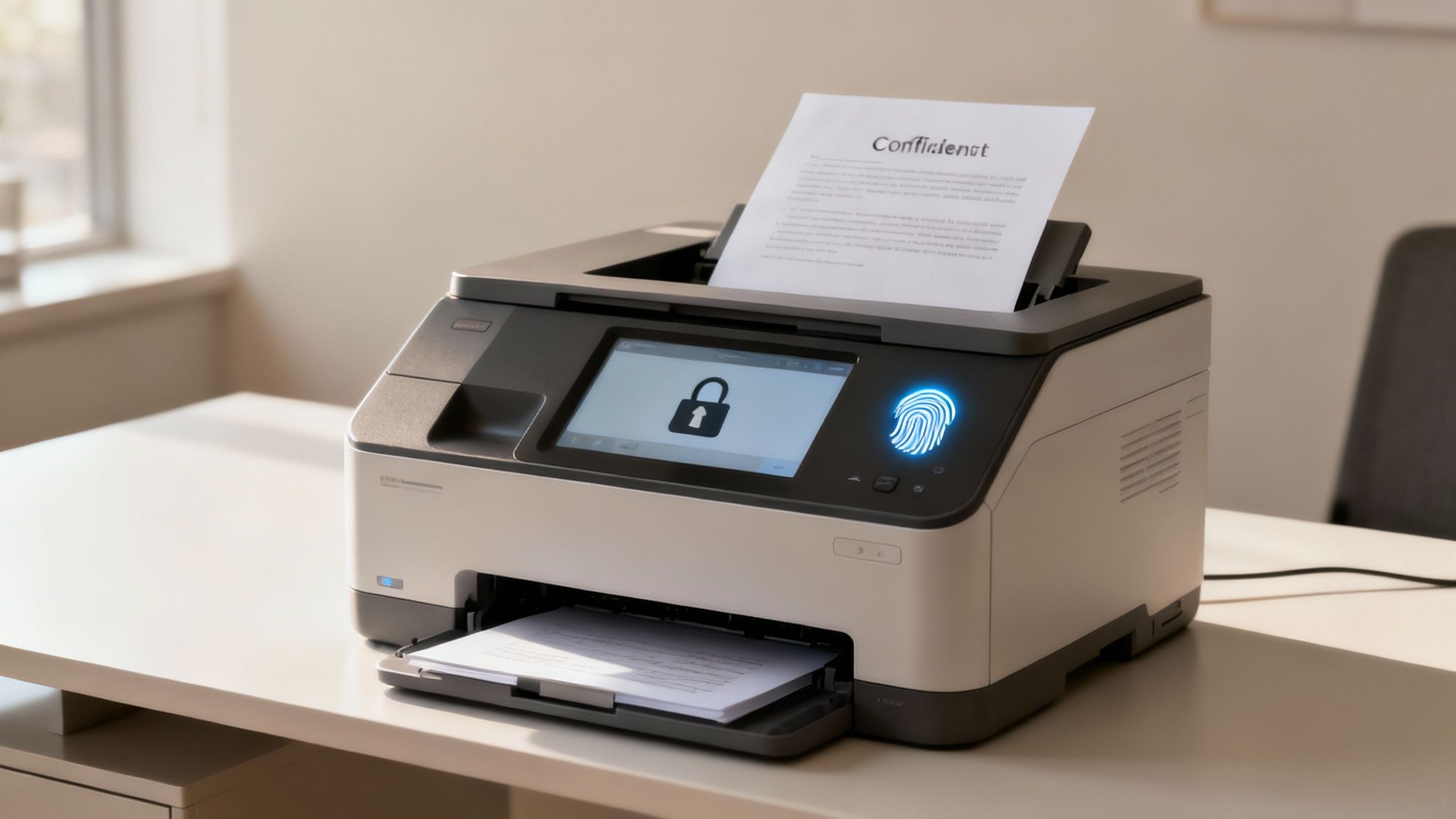
This level of control is essential for industries handling regulated data under frameworks like HIPAA, GDPR, or PCI-DSS. For instance, a healthcare provider can use secure print release to prevent patient records from being left unattended in a printer tray, a common source of HIPAA violations. Similarly, financial institutions protect sensitive client data with encrypted print jobs that are unreadable if intercepted. For a broader perspective on how modern platforms approach data protection, it's helpful to explore resources on understanding robust security measures.
How to Implement This Benefit
To fortify your print environment, work with your MPS provider to deploy a comprehensive security framework tailored to your specific compliance and risk-management needs.
- Implement User Authentication: Require users to authenticate at every device using a PIN, ID card, or mobile app before they can print, scan, or copy documents.
- Enable Audit Trails: Activate and regularly review comprehensive logs that track all device activity. This provides a clear audit trail to identify who accessed what information and when.
- Proactive Firmware Management: Ensure your MPS provider includes regular firmware and security patch updates in your service agreement to protect against emerging threats. Learn more about the importance of cybersecurity for growing businesses to see how this fits into a larger strategy.
4. Enhanced Productivity and Efficiency
One of the most significant managed print services benefits is the boost to overall operational efficiency. By outsourcing printer fleet management, you free your internal teams from time-consuming tasks like troubleshooting device errors, ordering toner, and performing routine maintenance. This shift allows employees, particularly IT staff, to redirect their focus toward core business activities and strategic initiatives rather than reactive support.
Proactive monitoring and automated supply replenishment mean that printers are consistently operational, minimizing workflow interruptions. For instance, a manufacturing facility can improve its document workflow efficiency by up to 40% by eliminating delays caused by printer downtime. Similarly, corporate offices often report a reduction in IT support tickets related to printing by over 60%, showcasing a direct impact on productivity.
How to Implement This Benefit
To truly enhance productivity, your MPS strategy must be built on clear expectations and proactive management. This ensures that your provider actively works to prevent disruptions rather than just reacting to them.
- Establish Clear SLAs: Define strict Service Level Agreements (SLAs) with your provider, specifying guaranteed response and resolution times for any printer issues.
- Leverage Analytics: Use the data and analytics from your MPS provider to identify workflow bottlenecks and opportunities for process optimization.
- Conduct Regular Staff Training: Ensure employees are properly trained on new device features and best practices to reduce user-generated errors and maximize the utility of the print environment. This simple step can significantly decrease help desk calls and keep operations running smoothly.
5. Scalability and Flexible Infrastructure
A key managed print services benefit is the ability to adapt your printing infrastructure to your business's evolving needs without incurring major capital expenses. Traditional print management locks you into hardware that quickly becomes outdated or insufficient. Managed Print Services (MPS) replaces this rigid model with a flexible, service-based approach that allows you to scale resources up or down on demand.
This flexibility is crucial for dynamic organizations. For example, a startup scaling from 50 to 500 employees can seamlessly add new devices without complex procurement processes. Similarly, a retail chain can deploy additional printers for seasonal staff during peak holiday seasons and remove them afterward, paying only for the service when needed. This prevents capital from being tied up in underutilized assets and ensures your infrastructure always matches your current operational requirements.
How to Implement This Benefit
To leverage the full scalability of MPS, focus on building flexibility directly into your service agreement and operational planning.
- Negotiate Flexible Contract Terms: Ensure your contract includes clauses that allow for the easy addition or removal of devices without severe penalties. This gives you the freedom to adjust to market changes.
- Plan for Growth: Work with your provider to forecast future needs, planning for 20-30% growth headroom in your device allocation. This proactive step prevents bottlenecks as your company expands.
- Maintain Regular Communication: Keep your MPS provider informed about significant business changes, such as acquisitions, new office openings, or workforce adjustments. This dialogue ensures they can proactively align your print environment with your strategic direction.
6. Advanced Analytics and Reporting Capabilities
Beyond just managing devices, a key managed print services benefit is the wealth of data and actionable insights provided through advanced analytics. MPS platforms transform your print environment from an unmonitored cost center into a transparent, data-rich ecosystem. They collect detailed information on printing behavior, device performance, supply consumption, and user activity, giving you a powerful tool for strategic decision-making.
This granular reporting allows organizations to see exactly where resources are being allocated and identify significant areas of waste. For instance, a large healthcare network can use these analytics to discover that 15% of its specialty toner is being used for non-essential internal documents. By implementing a rule to restrict color printing for specific applications, the organization can generate immediate and substantial savings without impacting patient-facing operations.
How to Implement This Benefit
To turn raw data into measurable improvements, you must approach analytics with a clear strategy. Use the insights to guide policy creation and workflow optimization rather than just collecting reports.
- Establish a Baseline: Before making any changes, use the initial reports to establish a clear baseline of your current print volumes, costs per department, and user behaviors.
- Focus on High-Impact Users: Isolate the top 10-20% of users or departments with the highest print volumes and focus your initial policy adjustments and educational efforts there for the quickest ROI.
- Share Reports for Accountability: Make departmental print usage reports transparent. When teams can see their own consumption data, it naturally encourages more responsible printing habits and creates a culture of cost-consciousness.
7. Simplified IT Management and Support
A significant advantage of managed print services is the immediate relief it provides to internal IT departments. By transferring the day-to-day responsibilities of printer monitoring, maintenance, and user support to a specialized provider, MPS frees your IT team from time-consuming, repetitive tasks. This shift allows your internal experts to focus on core business objectives and strategic initiatives rather than troubleshooting paper jams or toner issues.
This offloading of tasks significantly reduces the volume of print-related support tickets, with some organizations reporting a reduction of over 70%. For a global company with thousands of devices, an MPS provider can centralize administration through a single console, simplifying management across geographically dispersed locations. This streamlined approach not only boosts efficiency but also enhances your overall IT strategy. Learn more about comprehensive IT support services that complement this model.
How to Implement This Benefit
To ensure a smooth transition and maximize the offloading of IT burdens, clear communication and planning with your MPS provider are essential.
- Establish Clear SLAs: Define specific service level agreements (SLAs) for response times, issue resolution, and preventative maintenance to hold your provider accountable.
- Integrate Management Tools: Work with your provider to ensure their management platform integrates seamlessly with your existing IT service management (ITSM) tools for unified reporting and visibility.
- Document a Transition Plan: Create a detailed plan that outlines the handoff procedures, defines roles and responsibilities, and establishes a clear communication protocol between your IT team and the MPS support desk. This ensures a seamless switch with minimal disruption.
8. Access to Latest Technology Without Capital Expenditure
One of the most strategic managed print services benefits is gaining access to the latest printing technology without the prohibitive upfront cost. Instead of purchasing new equipment, which becomes a depreciating asset, Managed Print Services (MPS) provides state-of-the-art devices as part of the service agreement. This approach keeps your office equipped with the latest features, security protocols, and efficiency enhancements.
This model effectively transforms technology acquisition from a large capital expenditure (CapEx) into a predictable operational expense (OpEx). For instance, a growing healthcare practice can access next-generation multifunction printers with advanced HIPAA-compliant security features and mobile printing capabilities without a major investment. The MPS provider handles the entire technology refresh cycle, ensuring your equipment never becomes obsolete.
How to Implement This Benefit
To ensure you are leveraging the most current technology, it is crucial to build clear expectations into your service-level agreement (SLA).
- Negotiate Refresh Cycles: Clearly define the frequency and timing of equipment upgrades in your contract to prevent technology stagnation.
- Specify Technology Standards: Work with your provider to set minimum technology requirements for any replacement devices, ensuring they meet your security and feature needs.
- Plan for Adoption: Schedule training sessions for your team whenever new equipment is installed. This ensures employees can fully utilize new features like cloud printing or advanced scanning workflows, maximizing your return on investment.
9. Standardization and Consistency Across Organization
One of the key strategic managed print services benefits is achieving operational consistency by standardizing your print environment. Instead of a patchwork of different devices, drivers, and user interfaces, Managed Print Services (MPS) streamlines your fleet. This creates a uniform experience for all users, regardless of their department or physical location, simplifying management and support.
Standardization simplifies everything from user training to IT troubleshooting and supply procurement. For example, a healthcare system with multiple clinics can deploy the same multifunction printer model across all facilities. This ensures that every employee knows how to operate the devices, scan documents into the EHR system securely, and follow the same HIPAA-compliant workflows, drastically reducing errors and training overhead.
How to Implement This Benefit
To leverage standardization effectively, a thoughtful rollout is crucial. The goal is to create enterprise-wide consistency while accommodating specific departmental needs.
- Conduct an Organization-Wide Assessment: Before selecting hardware, work with your MPS provider to map out existing devices and identify unique workflow requirements across different departments.
- Involve Key Stakeholders: Include representatives from IT, finance, and department heads in the device selection process to ensure the chosen standard meets diverse operational needs and gains widespread buy-in.
- Phase the Rollout: Implement the new standardized fleet in stages, starting with a pilot department. This approach minimizes disruption and allows you to gather feedback and refine the process before a full-scale deployment.
10. Business Continuity and Disaster Recovery Support
Disruptions, whether from equipment failure, natural disasters, or cyberattacks, can halt business operations. A key managed print services benefit is the built-in support for business continuity and disaster recovery (BCDR), ensuring your critical document workflows remain operational even when the unexpected happens. MPS providers create a safety net with rapid device replacement, pre-configured backup equipment, and alternative printing solutions.
This proactive planning is crucial for industries where downtime is not an option. For instance, a healthcare clinic can maintain access to patient records during a primary printer failure by immediately switching to a designated backup device. Similarly, a financial institution can continue processing loan documents without interruption, safeguarding revenue and client trust. This resilience is a fundamental part of a comprehensive IT strategy. For a deeper understanding, explore why every San Antonio business needs managed IT and cybersecurity services.
How to Implement This Benefit
To fully leverage BCDR support, it must be an integral part of your MPS agreement from the beginning. Clearly define response times and recovery objectives with your provider.
- Establish Clear BCDR Procedures: Document specific disaster recovery protocols within your MPS contract, including escalation contacts and expected device replacement timelines.
- Deploy Backup Devices Strategically: Work with your provider to place backup printers and multifunction devices in critical locations to minimize workflow disruption during an outage.
- Conduct Regular Testing: Schedule and perform regular tests of your print continuity plan. This ensures that backup procedures work as intended and that staff are familiar with the process, preventing panic and confusion during a real event.
Managed Print Services: 10-Benefit Comparison
| Item | Implementation Complexity 🔄 | Resource Requirements ⚡ | Expected Outcomes ⭐📊 | Ideal Use Cases 💡 | Key Advantages ⭐ |
|---|---|---|---|---|---|
| Cost Reduction and Predictable Budgeting | Moderate 🔄 (contracting, usage tracking) | Low ⚡ (vendor-billed, baseline audit) | High — ~20–30% cost reduction; predictable monthly spend | High-volume print organizations, law/healthcare firms | Predictable fees, lower TCO, consolidated vendor management |
| Reduced Environmental Impact | Moderate 🔄 (device config & behavior change) | Moderate ⚡ (energy-efficient devices, recycling programs) | Strong — 30–40% paper reduction; lower energy use | Organizations with ESG targets, universities | Lower footprint, certification support, consumable diversion |
| Improved Security and Data Protection | High 🔄 (auth, encryption, audit controls) | Moderate–High ⚡ (secure hardware, training) | High — reduces breach risk; supports HIPAA/GDPR/PCI compliance | Healthcare, finance, legal, regulated enterprises | Encrypted storage, secure print release, audit trails |
| Enhanced Productivity and Efficiency | Low–Moderate 🔄 (monitoring, SLAs) | Low ⚡ (proactive support, automated supplies) | High — 60–70% less IT time; 99%+ device uptime | Mid-size to large offices needing uptime and IT relief | Reduced downtime, faster repairs, freed IT resources |
| Scalability and Flexible Infrastructure | Low 🔄 (usage-based scaling via provider) | Low ⚡ (no capex; flexible deployments) | Moderate–High — scale up/down without major investment | Startups, seasonal retailers, M&A scenarios | Scale without capex, multi-site fleet management |
| Advanced Analytics and Reporting Capabilities | Moderate–High 🔄 (integration, privacy controls) | Moderate ⚡ (dashboards, analytics tools) | High — identifies 20–30% unnecessary printing; predictive maintenance | Enterprises needing cost visibility and chargeback | Actionable insights, policy enforcement, trend analytics |
| Simplified IT Management and Support | Low–Moderate 🔄 (transition & integration) | Low ⚡ (centralized management, remote troubleshooting) | High — 50–70% reduction in IT overhead; centralized control | Distributed organizations, multi-location IT teams | Centralized fleet control, SLA-backed support, standardization |
| Access to Latest Technology Without CapEx | Low 🔄 (contracted upgrade cycles) | Low ⚡ (provider-managed refresh, no capex) | High — regular upgrades, improved security and features | Firms wanting new tech without capital spending | Always-current devices, reduced obsolescence, security updates |
| Standardization and Consistency Across Organization | Moderate 🔄 (change management, stakeholder alignment) | Moderate ⚡ (training, standardized configs) | High — 80–90% device standardization; lower support complexity | Multi-national enterprises, regulated sectors | Consistent workflows, easier training, fewer compatibility issues |
| Business Continuity and Disaster Recovery Support | Moderate 🔄 (DR planning, SLAs) | Moderate ⚡ (backup devices, geographic redundancy) | High — rapid replacement; minimized operational interruptions | Critical operations, healthcare, finance, emergency services | Rapid device replacement, loaner programs, prioritized recovery |
Your Next Step: Transforming Print Management into a Strategic Advantage
The evidence is clear: the benefits of managed print services offer a powerful, multi-faceted solution to some of the most persistent challenges in modern business operations. Moving beyond the outdated view of printing as a simple office necessity, we've explored how a strategic MPS approach transforms it into a pillar of organizational efficiency, security, and financial prudence. The journey from a reactive, unpredictable print environment to a proactive, streamlined ecosystem is not just an upgrade; it's a fundamental business transformation.
Synthesizing the Strategic Value of MPS
We've covered a wide array of advantages, from tangible cost savings to enhanced data security. Let's distill these down to the core strategic impacts:
- Financial Control and Predictability: The most immediate impact is shifting from volatile, unpredictable print-related expenses to a fixed, manageable monthly cost. This allows for accurate budgeting and frees up capital that was previously trapped in emergency supply orders and unexpected repair bills.
- Strengthened Security Posture: In an era of constant cyber threats, every unsecured device is a liability. MPS hardens your print infrastructure, turning potential vulnerabilities into monitored, protected assets, which is critical for regulated organizations in healthcare and finance.
- Operational Efficiency and Focus: By offloading the entire lifecycle of print management, you liberate your IT team. Their time is better spent on strategic, revenue-generating projects rather than troubleshooting paper jams or managing toner inventory. This directly boosts productivity across the entire organization.
The cumulative effect of these managed print services benefits is undeniable. It's about more than just printers; it's about building a more resilient, agile, and competitive business. For organizations in San Antonio, especially those in regulated fields or with multiple locations, integrating MPS is a decisive step toward operational excellence.
Your Actionable Roadmap to a Smarter Print Strategy
Realizing these benefits begins with a single, crucial step: a comprehensive assessment of your current print environment. This isn't just about counting devices; it's a deep dive into your workflows, costs, security protocols, and user behaviors. A thorough print assessment will provide the data-driven insights needed to build a tailored MPS strategy that aligns perfectly with your business goals.
By partnering with an expert provider, you ensure this strategy is not implemented in a vacuum. It becomes an integral part of your broader IT and cybersecurity framework, supporting compliance requirements like HIPAA and fortifying your overall risk management efforts. The ultimate goal is to create a seamless, secure, and cost-effective infrastructure where printing supports your mission instead of draining your resources. It’s time to take control and turn a long-standing operational cost into a genuine strategic advantage.
Ready to unlock these benefits for your San Antonio business? Defend IT Services specializes in integrating Managed Print Services with comprehensive IT support and cybersecurity, providing a holistic solution that protects and streamlines your entire operation. Visit Defend IT Services to schedule your complimentary print assessment and discover how much you can save.