
In today's complex operational environment, simply knowing what IT assets you have is no longer enough. For small to midsize businesses and highly regulated organizations, effective IT asset management (ITAM) has evolved from a simple inventory task into a critical strategic function. It serves as the bedrock of robust cybersecurity, operational efficiency, and financial prudence.
Mismanaged assets often lead to significant security vulnerabilities, costly compliance failures, and wasted resources in the form of shadow IT and underutilized software licenses. A poorly tracked device can become an unsecured entry point for threats, while unmonitored software can result in crippling audit penalties. Conversely, a mature ITAM program provides a single, reliable source of truth for every piece of hardware and software your organization owns. This clarity is essential for securing every endpoint, optimizing technology spending, and making data-driven decisions that propel business growth.
This article cuts through the noise to deliver a comprehensive guide to essential it asset management best practices. We will provide a clear, actionable roadmap to transform your asset oversight from a reactive chore into a proactive, value-generating powerhouse. You will learn how to implement systems that not only track your assets but also protect them, ensure compliance, and maximize their return on investment throughout their entire lifecycle. From inventory and security to cost optimization and governance, these practices will help you build a resilient and efficient IT infrastructure.
1. Comprehensive Hardware and Software Inventory Management
A cornerstone of effective it asset management best practices is maintaining a complete and accurate inventory of all hardware and software assets. This foundational step involves creating a single source of truth, often called a configuration management database (CMDB) or a centralized asset repository. This database catalogs every piece of technology your organization owns, from physical servers and workstations to software licenses and cloud subscriptions.
Without a precise inventory, managing asset lifecycles, ensuring security, and controlling costs becomes nearly impossible. This practice moves beyond a simple spreadsheet, leveraging automated discovery tools to continuously scan your network and catalog assets, supplemented by periodic manual audits for verification. The goal is to create a dynamic, real-time view of your entire IT environment.
Why It's a Foundational Practice
A comprehensive inventory is the bedrock upon which all other ITAM processes are built. It directly impacts your ability to manage costs by identifying underutilized software licenses and redundant hardware. It enhances security by ensuring no unauthorized devices or software are on your network, and it streamlines compliance by providing auditors with a clear, verifiable record of all IT assets.
For regulated industries like healthcare or finance, an accurate inventory is non-negotiable for meeting strict compliance mandates like HIPAA. Knowing exactly what assets you have, where they are, and who uses them is the first step toward securing sensitive data and passing audits.
Actionable Implementation Steps
- Establish a Clear Classification System: Categorize assets by type (e.g., servers, laptops, printers), status (e.g., in-use, in-stock, retired), and business criticality. This helps prioritize management efforts.
- Automate Discovery: Deploy tools that automatically scan your network to discover and identify all connected hardware and installed software. Schedule these scans to run at least weekly to capture changes quickly.
- Implement Check-In/Check-Out Procedures: For any asset movement, such as assigning a new laptop or decommissioning a server, enforce a formal process to update the inventory record immediately.
- Reconcile and Audit Regularly: On a quarterly basis, reconcile your IT inventory against financial records from your procurement department. This helps catch discrepancies and ensures financial accuracy. Even a simple inventory of your printers can reveal significant cost-saving opportunities. Learn more about how managed print services can optimize your office.
2. Asset Lifecycle Management and Planning
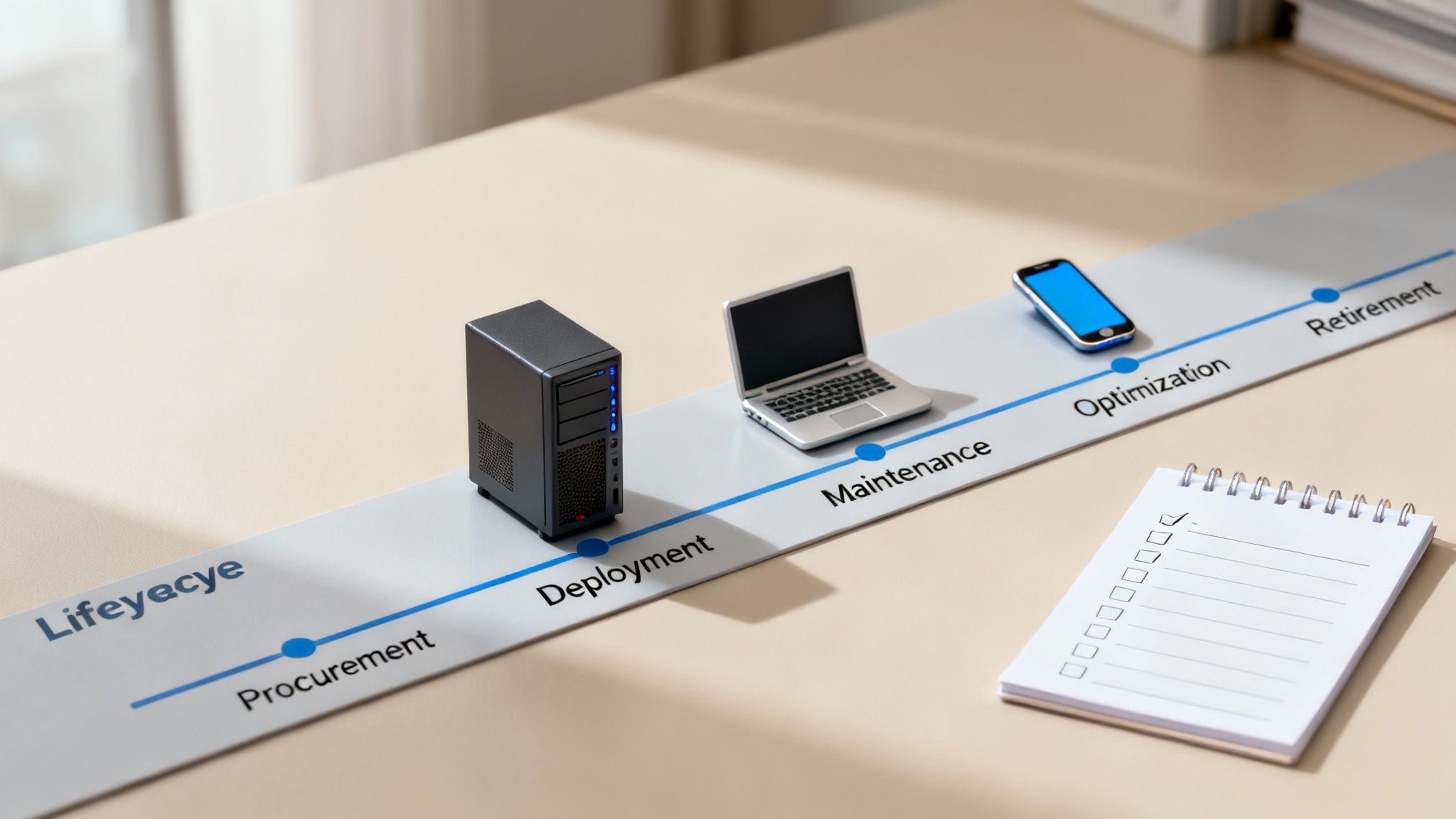
Beyond simply knowing what you have, a core component of it asset management best practices is strategically managing assets from acquisition through disposal. This involves tracking each piece of hardware and software through its complete lifecycle: planning, procurement, deployment, maintenance, and finally, retirement. This holistic approach ensures assets deliver maximum value while controlling their total cost of ownership (TCO) and mitigating risks associated with obsolete technology.
A well-defined lifecycle plan prevents the unexpected costs and security vulnerabilities that arise from outdated equipment. It transforms asset management from a reactive, break-fix model into a proactive, strategic function that aligns IT investments with business goals. For example, a planned five-year server refresh cycle, informed by performance data and support costs, is far more efficient than waiting for critical hardware to fail.
Why It's a Foundational Practice
Effective lifecycle management directly impacts your bottom line and operational security. It allows you to forecast technology needs, budget accurately for future purchases, and avoid the premium costs of emergency procurements. By tracking maintenance and support costs over an asset's life, you can identify the optimal point for replacement, balancing performance against expense.
For regulated organizations, documenting every stage of an asset's life is crucial for compliance. A complete audit trail, from purchase order to a certificate of data destruction, demonstrates due diligence and protects sensitive information. This structured process ensures that when an asset is retired, all data is securely wiped, and the hardware is disposed of in an environmentally and legally compliant manner.
Actionable Implementation Steps
- Define Standard Lifecycle Phases: Establish clear, documented stages for all asset types (e.g., Procurement, In Use, Maintenance, Awaiting Disposal, Retired). Define the specific criteria and approvals required to move an asset from one stage to the next.
- Integrate with Financial Planning: Connect your asset lifecycle schedule directly with the capital budgeting process. This ensures that funds are allocated for planned hardware refreshes and software upgrades well in advance.
- Automate Lifecycle Tracking: Use your ITAM software to track asset age, warranty status, and maintenance history. Set up automated alerts for assets approaching their end-of-life or end-of-support dates to trigger the replacement process.
- Establish a Formal Retirement Process: Create a standardized, secure process for decommissioning assets. This must include secure data sanitization, license reclamation, and partnering with certified e-waste and recycling vendors to ensure proper disposal.
3. Software License Compliance and Optimization
A crucial component of modern it asset management best practices is the active management of software license compliance and optimization. This practice ensures your organization adheres to the terms of all software agreements, avoiding costly legal penalties and audit failures. It moves beyond simple tracking to strategically analyze and optimize software usage, preventing overspending on unnecessary or underutilized licenses.
Effective software asset management (SAM) involves a continuous process of monitoring installations and usage against purchased entitlements. By creating a clear picture of your software landscape, you can identify opportunities for cost savings, reallocate licenses where they are most needed, and make informed decisions during vendor negotiations and renewals. This proactive approach turns software from an unmanaged expense into a strategically controlled asset.
Why It's a Foundational Practice
Software license management directly impacts both your bottom line and your risk profile. Non-compliance can lead to severe financial penalties from vendors like Microsoft or Oracle, with audit true-up costs often reaching six or seven figures. For regulated industries, proving software legitimacy is a core part of compliance and security audits.
Beyond risk mitigation, optimization unlocks significant savings. By identifying unused licenses for expensive software like Adobe Creative Cloud or specialized engineering applications, you can either reharvest them for other users or eliminate them from your next renewal contract. This ensures you only pay for what you actually need, maximizing the value of your IT budget.
Actionable Implementation Steps
- Implement a SAM Tool: Deploy a dedicated Software Asset Management tool to automate the discovery of installed software and track usage. Tools like Flexera or Snow Software can centralize license entitlements and compare them against actual deployments.
- Conduct Regular Internal Audits: Perform internal software license audits at least annually. This helps you identify and address compliance gaps before a vendor-initiated audit occurs, giving you time to remediate issues on your own terms.
- Establish a Software Request Process: Create a formal, centralized process for requesting, approving, and procuring new software. This prevents "shadow IT" and ensures that every new purchase is properly licensed, tracked, and necessary for business operations.
- Centralize License Documentation: Maintain a secure, centralized repository for all software purchase records, contracts, and license entitlement documents. This documentation is essential for proving ownership during an audit and for understanding renewal terms.
4. IT Asset Security and Data Protection
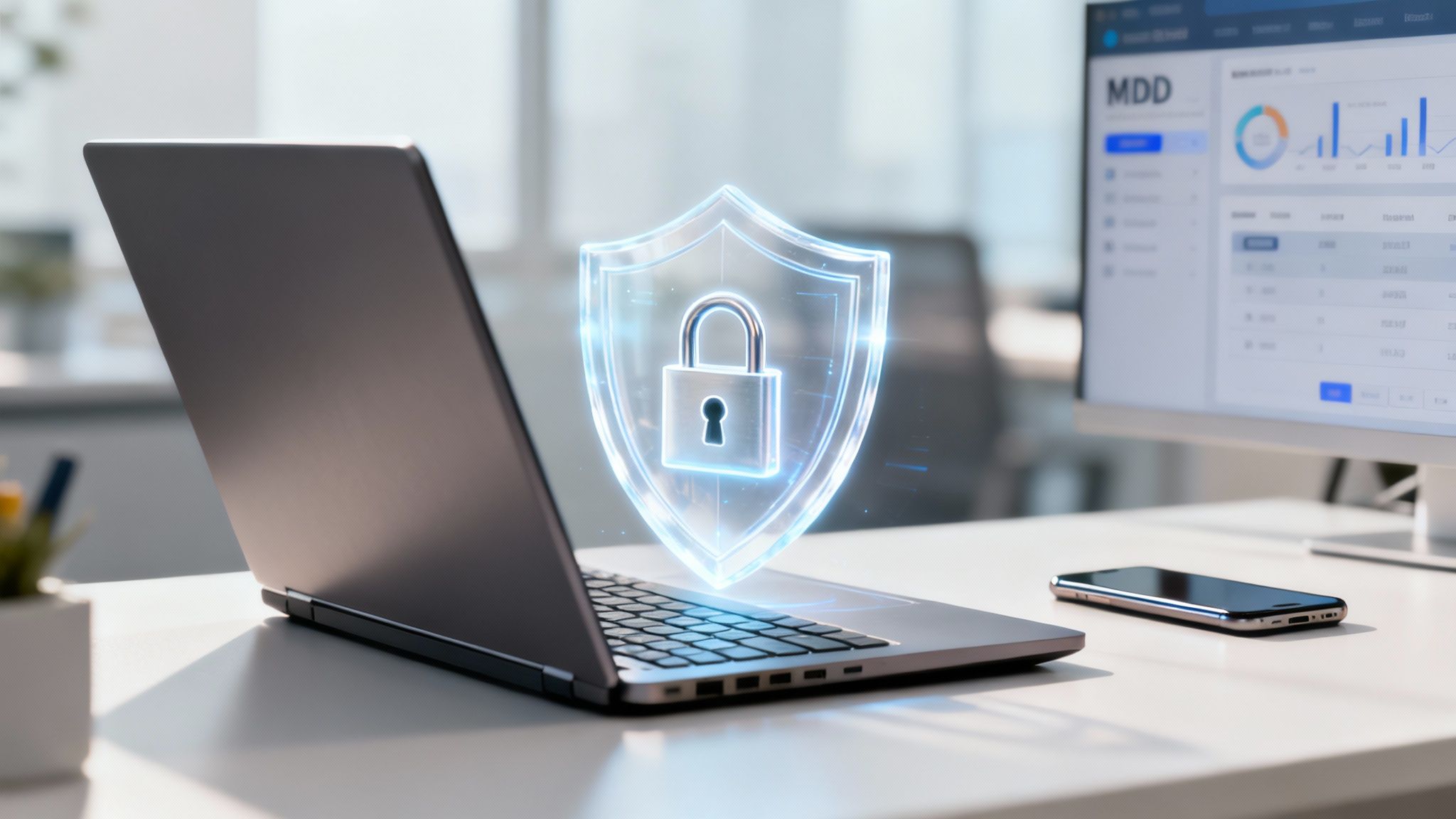
A critical component of modern it asset management best practices is the integration of robust security controls and data protection measures. This practice goes beyond tracking assets; it involves actively securing them throughout their lifecycle. It focuses on hardening devices, encrypting data, and implementing management systems to prevent unauthorized access, data breaches, and physical theft.
This security-centric approach ensures that every asset, from a company-issued laptop to a personal smartphone accessing corporate data, adheres to strict security policies. It leverages tools like Mobile Device Management (MDM) and Unified Endpoint Management (UEM) to enforce these policies remotely, providing capabilities like remote data wipes for lost or stolen devices and ensuring a consistent security posture across the entire asset portfolio.
Why It's a Foundational Practice
In an era of increasing cyber threats and stringent data privacy regulations, treating asset management as a security function is no longer optional. An unsecured device is a direct gateway into your network for attackers. By integrating security with ITAM, you create a powerful defense-in-depth strategy, ensuring that every endpoint is a hardened target rather than a vulnerability.
This practice is essential for protecting sensitive intellectual property and customer data. Central to protecting IT assets and data is implementing comprehensive cyber security risk management strategies, crucial for preventing breaches and ensuring compliance with regulations like GDPR and HIPAA. Without these controls, a lost laptop or a compromised mobile device can lead to catastrophic financial and reputational damage. Find out more about how managed IT and cybersecurity services can protect your business.
Actionable Implementation Steps
- Deploy a Mobile Device Management (MDM) Solution: Use a tool like Microsoft Intune or Jamf Pro to manage and secure all mobile devices, including both corporate-owned and BYOD assets.
- Enforce Full-Disk Encryption: Mandate and verify that full-disk encryption (e.g., BitLocker for Windows, FileVault for macOS) is enabled on all laptops and portable storage devices.
- Establish and Monitor Security Baselines: Create standard, secure configuration templates for different asset types. Use your ITAM system to continuously monitor devices for compliance and automatically remediate any deviations.
- Integrate Security Alerts with Your Asset Inventory: Connect your endpoint detection and response (EDR) tool with your asset database. When a security alert is triggered, it should be immediately associated with the specific asset, its owner, and its location, accelerating incident response.
5. Automated Asset Discovery and Reconciliation
A critical step in modern it asset management best practices is moving beyond manual data entry and embracing automation. This involves using specialized tools to automatically scan your networks, cloud environments, and endpoints to discover and identify every IT asset. This creates a dynamic, real-time inventory that is far more accurate and comprehensive than any manual effort could achieve.
Automated discovery tools continuously monitor your IT landscape, detecting new devices as they connect and noting when assets are decommissioned. This information is then used to automatically reconcile your asset database, flagging discrepancies between what is recorded and what actually exists. This process drastically reduces human error, closes security gaps, and provides an up-to-the-minute view of your entire technology portfolio.

Why It's a Foundational Practice
Manual asset tracking is inefficient, prone to errors, and simply cannot keep pace with today's dynamic IT environments. Automated discovery and reconciliation provide the accuracy and speed necessary to manage security risks, ensure compliance, and make informed financial decisions. It immediately identifies unauthorized "shadow IT" devices and software, which pose significant security threats.
For regulated industries, this practice provides a verifiable and continuous audit trail of all assets, proving that no unmanaged devices are accessing sensitive data. It ensures that every asset is accounted for, patched, and secured according to policy, which is fundamental for frameworks like HIPAA and PCI DSS.
Actionable Implementation Steps
- Deploy Network Discovery Tools: Implement solutions like ServiceNow Discovery or Qualys Asset Management to perform agentless and agent-based scans across all your network segments, including Wi-Fi networks.
- Integrate Cloud and Virtual Environments: Configure your discovery tools to connect to cloud platforms like AWS and Azure via APIs to catalog virtual machines, storage, and other cloud resources automatically.
- Schedule Regular Scans and Reconciliation: Schedule automated discovery scans to run at least daily, preferably during off-peak hours to minimize network impact. Set up automated reconciliation rules to flag discrepancies for review weekly.
- Establish Alerting for Anomalies: Configure alerts to notify your IT team immediately when a new, unknown device connects to the network or when a known asset has not been seen for a predefined period.
6. Integration with IT Service Management (ITSM) and Enterprise Systems
One of the most powerful it asset management best practices is to break down data silos by integrating your ITAM platform with other core business systems. This involves creating a connected ecosystem where asset data flows seamlessly between your ITAM tools, IT Service Management (ITSM) platforms, Enterprise Resource Planning (ERP) systems, and financial software. This integration transforms ITAM from a standalone function into a strategic enabler for the entire organization.
By connecting these systems, you provide context to every asset. For example, when an employee submits a support ticket through an ITSM tool like ServiceNow, the technician can instantly see the user's assigned hardware, software versions, and warranty status. This eliminates manual lookups and accelerates incident resolution, directly improving service delivery and employee productivity.
Why It's a Foundational Practice
Integrating ITAM and ITSM creates a symbiotic relationship that enhances both disciplines. Accurate asset data enriches service management processes like incident, problem, and change management. When planning a server upgrade, change managers can use ITAM data to identify all dependent applications and services, preventing unexpected outages.
This integration is also crucial for financial governance and compliance. Linking asset data to ERP systems like SAP or Oracle allows for precise cost allocation, accurate depreciation tracking, and streamlined financial reporting. For regulated industries, this creates an auditable trail connecting a physical asset to its financial record and service history, simplifying compliance verification.
Actionable Implementation Steps
- Map Data Requirements: Before integrating, identify which data fields from your ITAM system are needed by ITSM, finance, and HR. Create a clear data map to define the flow of information.
- Establish Master Data Governance: Designate the ITAM database as the single source of truth for asset information. Define clear ownership and processes for who can create, update, or retire asset records to prevent data conflicts.
- Leverage APIs for Synchronization: Use APIs and integration platforms (iPaaS) to ensure real-time or near-real-time data synchronization between systems. This prevents stale data from causing errors in service requests or financial reports.
- Link Assets to Service Tickets: Configure your ITSM platform to automatically link incidents and service requests to specific configuration items (CIs) from your asset database. This provides historical context for troubleshooting and helps identify problematic assets.
7. Cost of Ownership Analysis and Optimization
A critical, yet often overlooked, component of it asset management best practices is the thorough financial analysis of each asset's Total Cost of Ownership (TCO). This practice moves beyond the initial purchase price to calculate the full economic impact of an asset over its entire lifecycle. It encompasses everything from acquisition and deployment to ongoing operation, maintenance, support, training, and eventual disposal.
Adopting a TCO model provides a comprehensive financial lens through which to evaluate technology investments. It enables organizations to make data-driven decisions, justify budgets with clear ROI projections, and identify hidden costs that erode profitability. For instance, comparing the TCO of an on-premises server versus a cloud subscription reveals the true long-term financial commitment beyond just the upfront capital expenditure.
Why It's a Foundational Practice
Understanding TCO is foundational for strategic financial planning and cost optimization within IT. It transforms asset management from a purely operational task into a strategic financial function. This analysis directly supports decisions like setting optimal hardware refresh cycles for laptops or justifying data center consolidation projects by demonstrating long-term savings in energy and maintenance.
For businesses aiming to scale efficiently, a TCO analysis is essential. It prevents the accumulation of technical debt from seemingly "cheaper" short-term solutions that carry expensive long-term maintenance burdens. This financial discipline ensures that every dollar spent on technology is an informed investment aligned with business goals.
Actionable Implementation Steps
- Establish Standard Cost Categories: Define clear categories that align with your accounting practices, including hardware, software licenses, maintenance contracts, support labor, training, and even energy costs.
- Build TCO Models for Key Assets: Create standardized TCO templates for different asset types, such as workstations, servers, and network equipment. Use these models to compare potential new purchases and evaluate existing assets.
- Include Indirect and "Soft" Costs: Factor in costs like administrator time spent on maintenance, user downtime during upgrades, and security patching efforts to get a truly complete picture of an asset's financial impact.
- Update TCO Annually with Actual Data: Don't rely solely on initial estimates. On an annual basis, review and update your TCO calculations with actual cost data from the previous year to refine your models and improve future forecasting accuracy.
8. Risk Management and Compliance Tracking
A crucial component of modern it asset management best practices is integrating risk management and continuous compliance tracking. This practice moves ITAM beyond simple inventory, transforming it into a governance tool that identifies, assesses, and mitigates risks tied to each asset. It involves mapping assets to regulatory requirements, tracking vulnerabilities, managing patches, and documenting configurations to ensure you meet industry standards.
For organizations in regulated sectors like healthcare or finance, this is non-negotiable. It means ensuring every device handling patient data is HIPAA compliant or that every server processing payments meets PCI DSS standards. By linking compliance status directly to the asset record in your CMDB, you create an auditable trail that proves due diligence and simplifies regulatory reporting.
Why It's a Foundational Practice
Integrating risk and compliance into ITAM provides a clear, asset-level view of your security posture. It allows you to prioritize remediation efforts based on risk scores, focusing on the assets that pose the greatest threat to business operations or data integrity. This proactive approach prevents security breaches and costly compliance failures before they occur.
Furthermore, it streamlines audit preparation significantly. When an auditor requests proof of compliance, you can pull detailed reports directly from your asset management system, showing patch levels, configuration details, and access controls for specific asset groups. This turns a frantic, time-consuming audit process into a routine, manageable task.
Actionable Implementation Steps
- Map Regulations to Assets: Identify all applicable regulations (e.g., HIPAA, GDPR, PCI DSS) and map the specific controls and requirements to the relevant asset categories in your inventory.
- Implement Automated Compliance Scanning: Use tools that continuously scan asset configurations and compare them against established compliance baselines and security policies. These tools can automatically flag non-compliant assets.
- Establish a Risk Scoring System: Develop a methodology to assign a risk score to each asset based on its criticality, the data it holds, and its known vulnerabilities. Use this score to prioritize patch management and other remediation tasks.
- Document All Exceptions: For any asset that cannot meet a specific compliance control, maintain a formal documentation and approval process for the exception. This demonstrates a conscious risk acceptance decision to auditors.
9. Vendor Management and Strategic Sourcing
Effective vendor management is a critical, yet often overlooked, component of it asset management best practices. This procurement-focused discipline involves strategically managing relationships with hardware vendors, software providers, and service partners to optimize cost, support quality, and contractual terms. It moves beyond transactional purchasing to build long-term partnerships that yield better pricing, superior service, and greater value.
By centralizing and standardizing procurement, you gain significant leverage. Instead of disparate departments buying assets ad-hoc, a strategic sourcing approach enables you to negotiate volume discounts, secure favorable terms, and ensure that all purchased assets align with organizational standards for security, compatibility, and performance. This proactive management prevents vendor lock-in and ensures you receive the best possible return on your technology investments.
Why It's a Foundational Practice
Strategic vendor management directly impacts your bottom line and operational efficiency. Consolidating purchases with a select group of preferred vendors increases your negotiating power, leading to substantial cost savings. It also simplifies the support process, as your IT team develops deeper familiarity with a standardized set of products and has established relationships with vendor support teams.
Furthermore, this practice is essential for risk management. By thoroughly vetting vendors and establishing clear Service Level Agreements (SLAs), you can ensure partners meet your security and compliance requirements. This is particularly crucial for regulated industries where a vendor’s failure can create significant compliance exposure for your organization. A well-managed vendor relationship becomes an extension of your own IT and security framework.
Actionable Implementation Steps
- Consolidate and Standardize: Identify your top IT spend categories and consolidate purchases with a small number of preferred, vetted vendors. Standardizing on specific models from Dell or HP, for example, streamlines support and procurement.
- Establish Clear Performance Metrics: Define key performance indicators (KPIs) and SLAs for each critical vendor. Track metrics like hardware failure rates, support response times, and on-time delivery to hold partners accountable.
- Conduct Annual Vendor Reviews: Schedule formal annual reviews with key vendors to discuss performance against SLAs, review upcoming technology roadmaps, and renegotiate contract terms and pricing.
- Centralize Contract Management: Use a centralized repository or contract management tool to track all vendor agreements, renewal dates, and key terms. Set automated alerts for 90, 60, and 30 days before contract expiration to allow ample time for review and negotiation. Working with a trusted IT partner can streamline this entire process; see why local businesses choose DefendIt for their IT and security needs.
10. Asset Data Quality and Governance Framework
An advanced it asset management best practices approach is to establish a formal data quality and governance framework. This moves beyond simple data entry and creates an organizational system of policies, standards, and controls to ensure asset information is consistently accurate, complete, and trustworthy. The framework defines data ownership, sets quality thresholds, and implements processes for data maintenance, validation, and correction.
Without strong governance, even the best ITAM tools suffer from the "garbage in, garbage out" problem, leading to flawed decisions and security risks. A governance framework establishes the rules and responsibilities needed to maintain the asset database as a reliable source of truth, turning raw data into a strategic asset for financial planning, compliance, and security management.
Why It's a Foundational Practice
Data governance is the discipline that ensures your asset inventory remains valuable over time. It directly impacts your ability to trust the information used for critical decisions, such as software license compliance, hardware refresh cycles, and cybersecurity vulnerability assessments. For regulated industries, a demonstrable governance framework provides auditors with confidence that asset data is managed with integrity and control.
In financial services or healthcare, for example, accurately tracking an asset's data classification, physical location, and user access history is non-negotiable for compliance. A governance framework ensures this critical information is captured correctly and protected from unauthorized changes, forming a key pillar of your risk management strategy.
Actionable Implementation Steps
- Define Critical Data Elements (CDEs): Identify the most crucial data fields for your assets (e.g., owner, status, location, purchase date) and establish strict quality standards for each one.
- Assign Clear Data Ownership: Appoint data stewards at both operational and executive levels who are responsible for the accuracy and lifecycle of specific asset data categories.
- Implement Automated Validation Rules: Configure your ITAM system to automatically enforce data standards, such as mandatory fields, standardized naming conventions, and format validation, to prevent incorrect data entry.
- Establish Data Maintenance and Audit Cadences: Create a schedule for regular data quality audits, at least quarterly. To maintain the integrity and reliability of IT asset information, it's crucial to implement strong governance. For broader insights, consider these essential data governance best practices.
IT Asset Management: 10 Best Practices Comparison
| Item | 🔄 Implementation complexity | ⚡ Resource requirements | 📊 Expected outcomes | 💡 Ideal use cases | ⭐ Key advantages |
|---|---|---|---|---|---|
| Comprehensive Hardware and Software Inventory Management | Moderate–High: initial discovery, integrations, ongoing audits | Asset discovery tools, tagging (RFID/barcode), staff for maintenance | Accurate asset register; reduced shadow IT; license compliance | Enterprises needing single source of truth for assets | Improved budgeting & compliance; faster support — ⭐⭐⭐⭐ |
| Asset Lifecycle Management and Planning | High: cross-functional planning, procurement and finance alignment | Procurement, finance, lifecycle tracking tools, analytics | Predictable refresh cycles; optimized TCO; reduced obsolescence | Long-term IT planning; scheduled hardware refresh programs | Maximizes ROI and uptime; predictable costs — ⭐⭐⭐⭐ |
| Software License Compliance and Optimization | Medium–High: complex licensing models and audits | SAM tools, license specialists, audit processes | Cost savings; reduced legal risk; better vendor negotiation leverage | Large software estates; high audit exposure | Eliminates unused licenses; audit readiness — ⭐⭐⭐⭐⭐ |
| IT Asset Security and Data Protection | High: policy, MDM, encryption and monitoring deployment | Security tooling (MDM, EDR), training, incident response capability | Lower breach risk; regulatory compliance; rapid response | Regulated industries; BYOD and remote work environments | Strong risk reduction and audit trails — ⭐⭐⭐⭐⭐ |
| Automated Asset Discovery and Reconciliation | Medium: technical deployment, scanning, tuning and reconciliation | Discovery scanners/agents, network/cloud access, ops staff | Real-time visibility; immediate detection of new/rogue assets | Dynamic networks, hybrid cloud environments | Reduces manual inventory effort; finds shadow IT — ⭐⭐⭐⭐ |
| Integration with ITSM and Enterprise Systems | Very High: complex data mapping, CMDB and workflow integration | Integration engineers, APIs, governance, ERP/ITSM platforms | Unified asset-service view; faster incident/change resolution | Organisations using ITSM/ERP seeking single-pane operations | Eliminates silos; improves cost allocation and change risk — ⭐⭐⭐⭐ |
| Cost of Ownership Analysis and Optimization | Medium: financial modeling and data collection | Finance input, TCO tools, historical cost data | True TCO visibility; better procurement decisions; ROI analysis | Cloud vs. on-prem decisions; major procurements | Reveals hidden costs; supports budget justification — ⭐⭐⭐⭐ |
| Risk Management and Compliance Tracking | High: continuous monitoring, regulatory mapping and auditing | Compliance tools, security teams, audit processes | Reduced compliance violations; prioritized remediation; audit trails | Healthcare, finance, government and regulated firms | Proactive risk reduction; audit readiness — ⭐⭐⭐⭐ |
| Vendor Management and Strategic Sourcing | Medium: contract negotiation and performance monitoring | Procurement/legal teams, scorecards, supplier portals | Cost savings; improved service quality and supply reliability | Organizations with large vendor spend or standardization goals | Better pricing, SLAs and supplier performance — ⭐⭐⭐⭐ |
| Asset Data Quality and Governance Framework | High: policy creation, stewardship and change management | Data stewards, governance tools, training and audits | Trustworthy asset data enabling accurate reporting and analytics | Organizations needing reliable analytics and compliance | Improves decisions, reduces errors; accountability — ⭐⭐⭐⭐ |
From Theory to Action: Partnering for ITAM Success
Navigating the landscape of IT asset management can feel like piecing together a complex, ever-changing puzzle. We've explored ten foundational it asset management best practices, from establishing a comprehensive hardware and software inventory to implementing a robust data governance framework. Each practice represents a critical piece of the puzzle, designed to bring order, security, and financial intelligence to your technology ecosystem.
Moving beyond simple inventory lists, the true power of ITAM emerges when you embrace the full asset lifecycle, optimize software licenses to eliminate waste, and embed strong security controls at every stage. The goal is to transform your assets from a list of expenses into a portfolio of strategic enablers. This requires a shift in mindset, viewing ITAM not as a burdensome administrative task but as a continuous strategic initiative that directly impacts your bottom line and operational resilience.
Synthesizing the Core Principles for Lasting Impact
The journey to ITAM maturity is not about flawlessly executing every best practice overnight. Instead, it's about building a sustainable program that evolves with your organization. The most critical takeaways from our discussion revolve around three core themes: visibility, control, and optimization.
- Achieving Total Visibility: You cannot manage, secure, or optimize what you cannot see. Best practices like automated discovery, comprehensive inventory management, and integration with ITSM systems are all geared toward creating a single, reliable source of truth for your entire IT environment. This visibility is the bedrock upon which all other ITAM functions are built.
- Establishing Proactive Control: Gaining control means moving from a reactive state (fixing problems as they arise) to a proactive one (preventing them from happening). This is where lifecycle management, security protocols, and compliance tracking become indispensable. By standardizing processes for asset procurement, deployment, maintenance, and retirement, you minimize risks, ensure compliance, and enhance security posture.
- Driving Continuous Optimization: Effective ITAM is an engine for financial and operational efficiency. Through diligent software license management, total cost of ownership analysis, and strategic vendor management, you can uncover significant cost savings. This optimization extends beyond budgets, streamlining workflows and ensuring that every technology asset delivers maximum value to your business.
Key Insight: Successful IT asset management is not a one-time project but a dynamic, ongoing discipline. It requires a commitment to continuous improvement, adapting to new technologies, evolving security threats, and changing business needs.
Your Roadmap to Implementation and Success
For small and midsize businesses, especially those in regulated industries like healthcare or finance in the San Antonio area, implementing these it asset management best practices can seem daunting. The complexity of cloud assets, hybrid work environments, and stringent compliance requirements like HIPAA adds layers of difficulty. Internal teams are often stretched thin, lacking the specialized tools or dedicated time to build a mature ITAM program from the ground up.
This is where a strategic partnership can be a game-changer. Instead of struggling to piece together solutions, you can leverage the expertise of a dedicated team. A managed services partner provides the necessary framework, advanced tools, and proactive oversight to turn ITAM theory into practical, impactful action. This approach allows you to achieve enterprise-level control and security without the enterprise-level investment in a dedicated internal department. By offloading the operational burden, your team can focus on leveraging technology for strategic growth, confident that your assets are managed, secure, and fully optimized. The ultimate benefit is not just a well-organized asset register but a more resilient, efficient, and competitive organization.
Ready to transform your approach to asset management and fortify your business? The team at Defend IT Services specializes in implementing these IT asset management best practices for businesses in San Antonio, providing the expertise and tools needed to achieve total visibility, control, and optimization. Contact us today to learn how our managed IT and cybersecurity services can turn your technology assets into a powerful competitive advantage.