
Preventing a data breach in healthcare isn't a one-and-done task. It demands a living, breathing strategy that weaves together smart technology, ongoing staff education, and rock-solid security policies. This isn't just about ticking a compliance box; it's about building a fortress around your patients' trust and your ability to provide care.
The High Stakes of Healthcare Data Security

A data breach in a healthcare setting is a full-blown patient safety crisis. When a system's security is compromised, the fallout goes far beyond fines and legal headaches. It directly erodes patient trust and can cripple the delivery of life-saving care. To build a defense that actually works, you have to understand what you're up against.
The Modern Threat Landscape
Let’s be clear: cybercriminals hunt for healthcare data for a reason. Protected health information (PHI) is incredibly valuable on the black market. You can cancel a stolen credit card, but a patient's medical history is forever. It’s a permanent key for identity theft, complex fraud schemes, and even extortion.
The attackers' playbook is always changing. They're using sophisticated ransomware to paralyze entire hospital networks, sending cleverly disguised phishing emails to trick staff into giving up their logins, and finding backdoors through unsecured medical devices connected to your network. These are not random acts of digital vandalism; they are targeted, well-planned assaults designed for maximum impact.
A data breach isn't just a loss of files. In healthcare, it can mean canceled surgeries, delayed diagnoses, and a complete breakdown in the continuity of care, putting patient lives at immediate risk.
Common Points of Failure
To protect your organization, you first need to know where the cracks are. From my experience, most security incidents don't come from a brilliant, un-defendable hack. They come from common, and often preventable, weak spots.
- Insider Threats: This can be a disgruntled employee, but more often, it's a well-intentioned staff member who clicks a bad link or mishandles data simply because they haven't been properly trained.
- Unsecured Medical Devices: Every infusion pump, MRI machine, and heart monitor connected to the network is a potential doorway for an attacker if it isn't secured and regularly updated.
- Third-Party Vendor Risk: Think about all the partners you work with—billing companies, transcription services, IT contractors. If their security is lax, they become a liability to you.
The numbers really drive this home. Healthcare was responsible for a staggering 23% of all global data breaches in a recent year. Worse, between 2018 and 2022, ransomware attacks hit 654 healthcare organizations, exposing the records of nearly 89 million patients. These aren't just statistics; they're a massive warning sign.
For a deeper dive, you can explore this complete protection guide to healthcare data security. This kind of proactive security is central to the importance of cybersecurity for growing businesses, and it's absolutely non-negotiable in healthcare.
Building a Multi-Layered Cybersecurity Defense

In cybersecurity, there's no such thing as a silver bullet. The only way to truly protect patient data is by building intelligent, overlapping layers of defense. Think of it less like a single wall and more like a fortress with a moat, high walls, and guards at every gate. This approach shifts you from simply reacting to threats to proactively building a framework that can anticipate and neutralize them.
A core principle of this modern defense is a Zero Trust architecture. The philosophy is simple but powerful: never trust, always verify. This model assumes threats can come from anywhere—inside or outside your network. No user or device gets a free pass. Every single request to access data must be authenticated and authorized, which dramatically cuts down an attacker's ability to move around your network if they get past that first line of defense.
Conduct Meaningful Risk Assessments
You can't defend what you don't understand. That’s why regular, in-depth risk assessments are absolutely non-negotiable for any healthcare organization. These aren't just box-checking exercises for compliance; they are deep, honest dives into your IT environment to find the cracks before an attacker does.
A truly effective assessment goes way beyond a simple network scan. You need to meticulously evaluate:
- Data Flow: Where is protected health information (PHI) being created, where is it stored, and how is it sent? More importantly, who has access at every single step?
- System Patching: Are all your operating systems, software, and medical devices updated with the latest security patches? An unpatched server is practically a welcome mat for attackers.
- Access Controls: Who holds the keys to the kingdom with administrative privileges? Are you enforcing the principle of least privilege, ensuring staff can only access the data they absolutely need to do their job?
When you’re done, you'll have a clear, actionable roadmap for your security efforts. It turns the fuzzy idea of "risk" into a concrete to-do list you can actually manage.
Isolate Threats with Network Segmentation
Picture your entire IT network as one big, open-plan office. If one person gets sick, it’s not long before everyone is coughing. A flat network is just like that—one compromised device gives an attacker a potential shot at everything. This is precisely where network segmentation changes the game.
By dividing your network into smaller, isolated subnetworks, you’re creating digital fire doors. Your guest Wi-Fi, for example, should be completely separate from the network running your medical IoT devices or billing systems. If a visitor's malware-infected phone connects to the guest network, segmentation contains the threat right there, preventing it from ever reaching your critical patient records.
By compartmentalizing your network, you transform a potentially catastrophic, organization-wide breach into a manageable, isolated incident. This single practice can dramatically reduce the blast radius of a successful attack.
Protect Every Device with Advanced Endpoint Security
Every single desktop, laptop, server, and medical device connected to your network is an "endpoint." And every single one is a potential way in for an attacker. Let’s be clear: traditional antivirus software just isn't enough anymore to stop modern threats like fileless malware or sophisticated ransomware.
This is why advanced endpoint protection is so critical. These modern solutions bring a much more robust defense to the table, using a combination of technologies:
- Behavioral Analysis: Instead of just looking for known viruses, it watches for suspicious activity, allowing it to catch brand-new threats nobody has seen before.
- Threat Intelligence: It taps into a global network to learn about the latest attack methods and proactively block them before they hit you.
- Incident Response: When it does detect something, it gives you the tools to instantly isolate a compromised device from the network, stopping an attack dead in its tracks.
Trying to manage this level of security in-house, especially in a complex healthcare setting, can be overwhelming. Many organizations find that the most effective route is to partner with a provider for https://defenditservices.com/why-every-san-antonio-business-needs-managed-it-and-cybersecurity-services/ to get that 24/7 expert monitoring and response. And to make sure you're covering all your bases, a comprehensive HIPAA compliance checklist can be an invaluable resource.
Encrypt PHI Everywhere It Lives
Encryption is your last line of defense, and it's one of the strongest you have. If an attacker somehow gets through all your other layers and steals your data, encryption makes it completely unreadable and useless to them.
Your encryption strategy needs to cover data in two key states:
- Data at Rest: This is any PHI sitting on servers, hard drives, backup tapes, and employee laptops. Full-disk encryption should be standard-issue on any device that touches patient information.
- Data in Transit: This is PHI moving across your network or the internet—think emails or connections to an electronic health record (EHR) system. Using protocols like TLS ensures this data is securely scrambled as it travels.
Implementing end-to-end encryption isn't just a best practice; it's a clear mandate under HIPAA. It's what separates a lost laptop from becoming a multi-million-dollar breach notification.
Turning Your Staff Into a Human Firewall
While technology provides essential shields against cyberattacks, your employees are the true front line in the battle for patient data. They are also the most frequently targeted.
The most effective thing you can do to protect patient information is to transform your team from a potential vulnerability into a vigilant human firewall. This isn't about creating a culture of fear; it's about empowerment. When equipped with the right knowledge and tools, your staff can become your single greatest security asset. The goal is to cultivate an active security mindset that goes far beyond a passive, once-a-year training module.
This approach is non-negotiable. Human error and oversight remain a primary cause of security incidents in healthcare. The recent Ponemon Healthcare Cybersecurity Report found that 93% of healthcare organizations faced a cyberattack in the past year. What’s more telling is that a staggering 35% of the resulting data breaches were blamed on staff simply not following established security policies. You can dive deeper into the latest cybersecurity challenges on the American Hospital Association website.
Go Beyond Check-The-Box Training
Let's be honest: annual security training often feels like a chore. Employees click through slides just to get it over with, and very little information is actually retained. To make training stick, it has to be engaging, continuous, and directly relevant to their daily work.
It's time to ditch the long, dry presentations and focus on interactive, bite-sized learning. Instead of a generic module on "phishing," create a short video showing a realistic-looking email impersonating a senior doctor who is urgently asking for login credentials. Walk through the red flags right there on the screen—the mismatched sender address, the manufactured sense of urgency, the unusual request. This kind of context-rich training resonates far more than abstract definitions.
Security awareness is not a one-time event; it's an ongoing conversation. Consistent, small doses of education are far more effective at building lasting vigilance than a single, overwhelming annual session.
A well-structured training program is the cornerstone of building this awareness. It needs to be comprehensive, covering not just the "what" but the "why" behind each security practice.
To help you design or refine your program, here is a breakdown of the essential components every effective security training program should include.
Key Components of an Effective Security Training Program
| Training Component | Objective | Key Topics |
|---|---|---|
| Phishing & Social Engineering | Teach staff to recognize and report malicious attempts to steal credentials or data. | Email phishing, spear phishing, SMSishing (smishing), vishing (voice phishing), impersonation tactics. |
| Password Hygiene & Management | Reinforce the importance of strong, unique passwords and secure management practices. | Creating complex passphrases, dangers of password reuse, using password managers, multi-factor authentication (MFA). |
| HIPAA & Data Privacy | Ensure understanding of regulatory requirements and the ethical obligation to protect PHI. | Minimum necessary rule, patient privacy rights, safe handling of physical and digital records, social media policies. |
| Incident Reporting | Empower employees to report suspected incidents immediately without fear of blame. | How to identify a potential incident, who to contact (IT/security), what information to provide, why speed is critical. |
| Physical & Device Security | Promote awareness of security risks in the physical environment. | Securing workstations (screen locks), proper disposal of documents, preventing "shoulder surfing," lost/stolen device protocols. |
By weaving these elements into a continuous learning cycle, you move away from a compliance-focused task and toward building a genuine culture of security.
Run Realistic Phishing Simulations
The absolute best way for your team to learn how to spot a phish is by practicing on a safe battlefield. Regular, unannounced phishing simulations are an invaluable tool for building that muscle memory and keeping your staff on their toes.
A good simulation program should:
- Vary the Difficulty: Start with obvious phishing attempts and gradually introduce more sophisticated examples that use social engineering or impersonate trusted vendors.
- Provide Immediate Feedback: If an employee clicks a link, they should land on a page that gently explains what they missed. This turns a mistake into a powerful, in-the-moment learning opportunity.
- Track Metrics for Improvement: Monitor click rates over time to see where your vulnerabilities lie. If the billing department consistently falls for invoice-related scams, you know exactly where to focus your next training push.
This isn’t about catching people out; it’s about coaching them to succeed. When employees see these simulations as a safe way to learn, they become more confident in their ability to identify and report real threats.
Develop Clear and Simple Security Policies
Your security policies need to be a clear, easy-to-follow guide, not a dense legal document that gathers dust. If your policies are too complex or impractical, your staff will inevitably find workarounds that create security holes. The key is to make the secure way the easy way.
Take your password policy, for instance. Instead of just listing complex requirements, explain why they matter. Show a real-world example of how quickly a simple password can be cracked versus a longer passphrase. Then, provide tools like a password manager to make compliance nearly effortless.
Your policies must also clearly outline the procedure for reporting a suspected security incident. Make it simple and, most importantly, non-punitive. An employee who accidentally clicks a suspicious link should feel completely comfortable reporting it to IT immediately, knowing they won’t be blamed. That quick report is often the difference between a minor incident and a full-blown data breach.
Securing Your Supply Chain and Vendor Partnerships
Your security perimeter doesn't stop at your own four walls. It extends to every single vendor, partner, and third-party service that touches your systems or data. Think about it: the billing company processing payments, the cloud service hosting your EHRs, even the company that services your printers. Each one is a potential gateway for an attacker.
Ignoring this is like meticulously locking your front door but leaving all the windows wide open. A shocking number of healthcare data breaches don't start with a direct attack on the hospital, but with a compromised third-party vendor. Attackers are smart; they know smaller vendors might have weaker security, making them an easy stepping stone to the real prize: your patient data.
Vetting Vendors Before You Sign
This is your most critical moment. The due diligence you perform before a contract is signed is your first and best line of defense. It’s not just a box-ticking exercise; it's a deep dive into a potential partner's security culture.
You need to get past the simple "Are you secure?" question and demand proof.
- Security Certifications: Do they have a SOC 2 Type 2 report or are they HITRUST certified? These aren't just fancy acronyms; they represent independent, third-party validation that their security controls are actually working.
- Policies and Plans: Ask to see their internal security policies. More importantly, ask for their incident response plan. You want to know exactly how they'll react when something goes wrong.
- Access Controls: How, specifically, will they access your data? The only acceptable answer involves the principle of least privilege—their team gets access to the absolute minimum information required to do their job, and nothing more.
- Breach History: Have they been breached before? It's not always a deal-breaker, but their answer is telling. A good partner will be transparent about what happened, how they responded, and what they changed to prevent it from happening again.
If a vendor balks at providing this information, that’s a massive red flag. Real partners in security are open and transparent.
A vendor's security posture is a direct extension of your own. A vulnerability in their systems is a vulnerability in yours. Treat the vetting process with the same seriousness you apply to your internal security audits.
Writing Security Into Your Contracts
Once you've found a vendor you trust, it's time to get everything in writing. A handshake and a promise simply won't cut it when PHI is on the line. Your contracts need to be clear, enforceable security frameworks.
Of course, you’ll need a Business Associate Agreement (BAA) as required by HIPAA. This is the bare minimum. A BAA is a legal contract that formally outlines each party’s responsibilities for protecting PHI. But you really need to go further.
Your agreements must clearly define:
- Specific Security Controls: Don't be vague. Mandate things like encryption for all data (both at rest and in transit), multi-factor authentication for anyone accessing your systems, and regular vulnerability scanning.
- Breach Notification Timelines: This is huge. Specify that the vendor must notify you of a suspected breach within a strict timeframe, like 24 or 48 hours. You can't afford to wait weeks to find out you've been exposed.
- Right to Audit: You need the ability to verify their claims. Include a clause that gives you the right to audit their security controls or, at the very least, request third-party audit reports on an annual basis.
Continuous Monitoring and Risk Management
Vendor security isn't a "set it and forget it" activity. A partner that's secure today could have a critical vulnerability tomorrow. The threats are always changing, and your oversight has to be constant.
This doesn't mean you need to micromanage them. It’s about creating a rhythm of accountability. Schedule regular security check-ins. Require them to complete a security questionnaire annually to ensure their standards haven't slipped. You can even use third-party risk management tools that non-intrusively scan for public-facing vulnerabilities tied to your vendors.
And don't overlook the seemingly "low-risk" partners. Your print environment, for example, is full of networked devices that handle incredibly sensitive documents. Working with a secure managed print services provider ensures this often-forgotten part of your supply chain is locked down. A networked copier is still a computer, and it can absolutely become an attacker's entry point if left unsecured.
When you treat every single partnership as a vital part of your overall defense strategy, you build a far more resilient and secure organization.
Creating a Proactive Incident Response Plan
Let's be realistic: even with the best defenses in the world, the question in healthcare isn't if you'll face a security incident, but when. Prevention is always the goal, but how you react in those first few critical hours will define the outcome. Having a well-rehearsed incident response (IR) plan is what separates a managed crisis from a full-blown catastrophe.
Trying to figure things out on the fly during a breach is a recipe for disaster. The financial fallout from a slow response is just staggering. Healthcare breaches are already the most expensive, but the cost balloons the longer an attacker lurks in your network.
Think about this: the average breach takes a shocking 279 days to even identify and contain. And when an incident drags on for over 200 days, the average cost skyrockets to $5.01 million. You can see the full breakdown of these data breach impact numbers yourself—it's a sobering read.
Assembling Your Dedicated IR Team
When an alarm goes off, the first question can’t be, "Who's in charge here?" Your incident response plan has to start by assigning a dedicated IR team with roles and responsibilities that are crystal clear. This isn't just a list of names; it's a command structure built to operate under intense pressure.
This team needs to be a cross-functional group of your organization's heavy hitters:
- IT and Security Leadership: They're on the ground, leading the technical investigation and containment.
- Legal and Compliance: These are your guides through the tangled web of breach notification laws (HIPAA, HITECH, etc.).
- Executive Leadership: They're needed to make the tough calls on operations and authorize resources.
- Communications/PR: They manage the message to patients, staff, and the public, working to protect trust and your reputation.
- Clinical Operations: They need a seat at the table to assess and mitigate any impact on actual patient care.
Every single person on this team must know precisely what they're supposed to do, who they report to, and—critically—how to communicate securely if your primary networks are compromised.
The Critical Phases of Incident Response
A solid IR plan isn't a single "do this" item; it's a structured process that moves from initial chaos to full recovery. Following these phases ensures that in the heat of the moment, no crucial step gets missed.
The playbook generally involves identifying the threat, stopping its spread, kicking it out for good, and then carefully rebuilding. It's a methodical flow that covers everything from your internal systems to the third-party vendors who could be the source of the problem.
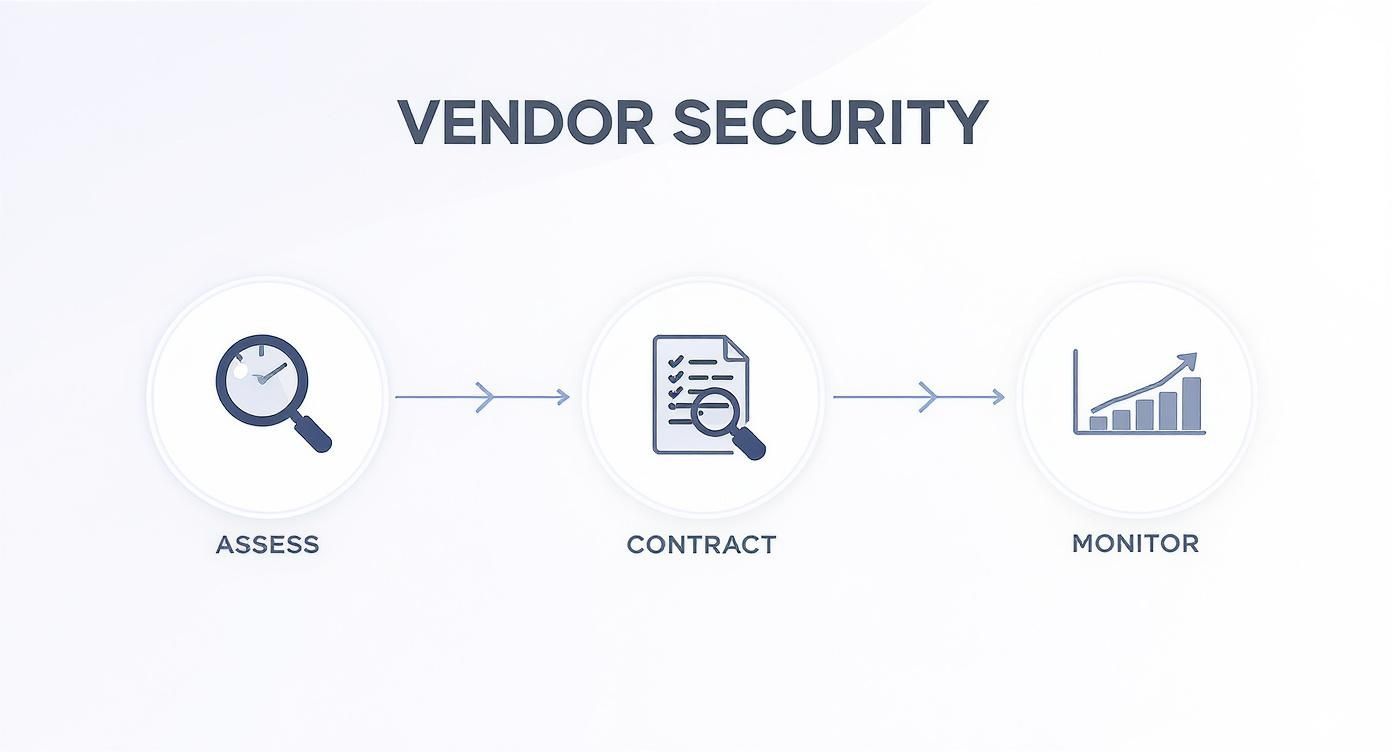
This structured approach prevents the kind of panic-driven mistakes that only make a bad situation worse.
- Containment: This is your first priority. Stop the bleeding. That could mean taking a compromised server offline, disabling a specific user's account, or even temporarily shutting down an application. Speed is everything. The longer an attacker has free rein, the more damage they can do.
- Eradication: Once contained, you have to get the threat out completely. This means finding the root cause—the vulnerability they exploited—and getting rid of every last trace of their presence. It's not enough to just delete the malware; you have to patch the hole they crawled through.
- Recovery: With the threat gone, the careful work of restoration begins. This is where having clean, tested backups becomes your saving grace. You'll be restoring data, rebuilding systems from secure images, and monitoring everything like a hawk to ensure the attacker didn't leave a backdoor behind.
A well-documented plan ensures a coordinated, logical response. Without it, teams are forced to make high-stakes decisions with incomplete information, often leading to critical errors that prolong the breach and increase its cost.
Building Muscle Memory with Tabletop Exercises
An incident response plan that just sits in a binder is completely useless. You wouldn't send a surgical team into the OR to try a new procedure without practice, and cybersecurity is no different. That’s why tabletop exercises are absolutely non-negotiable.
These are essentially drills. You get your IR team in a room and walk them through a simulated incident, like a ransomware attack that’s locked up your EHR system. They have to talk through their planned actions step-by-step, from detection to public notification.
These exercises are invaluable for a few reasons:
- You Find the Gaps: You’ll quickly discover the holes in your plan. Maybe the chain of command is fuzzy, or you realize you don't have a reliable way to communicate if email goes down.
- You Build Confidence: The team gets to practice working together under pressure, which builds the "muscle memory" they'll need when a real crisis hits.
- You Test Your Assumptions: You might think your backup recovery process is fast and reliable, but a tabletop exercise forces you to prove it.
Run these drills at least twice a year. This keeps your plan from getting stale and ensures your team can execute it flawlessly when it really counts.
Got Questions? We’ve Got Answers.
When you're deep in the trenches of healthcare IT, questions are going to come up. Even the most buttoned-up security strategy runs into unique situations and new threats that demand clear, straightforward answers. I've pulled together some of the most common questions I hear from healthcare pros to help you cut through the noise.
Let’s dig into some practical concerns and real-world challenges, reinforcing the core principles we've discussed with some actionable advice.
What Is the Single Biggest Security Mistake Healthcare Organizations Make?
This is a tough one, but if I had to pick just one, it’s complacency. So many organizations put in the hard work to build a solid security plan, get HIPAA-compliant, and then mentally check the box as if the job is done. The reality is that cybersecurity is never "done." It's a constant process of tweaking, learning, and staying vigilant.
The threat landscape is always shifting. The phishing email that tricked people last year looks completely different from the sophisticated social engineering attacks your staff face today. A business associate that passed your security review during onboarding could get breached tomorrow, putting your data at risk. The most dangerous assumption you can make is that yesterday's defenses are good enough for tomorrow's threats.
Security is a moving target. The organizations that truly get it right are the ones that build a culture of constant improvement. They're always reassessing risks, updating their defenses, and reinforcing employee training.
How Can Smaller Clinics Afford Robust Cybersecurity?
This is a huge, and completely valid, concern. It’s no secret that a small private practice doesn’t have the budget of a major hospital network. The good news is that effective security isn't just about buying the most expensive, top-of-the-line tools. It’s about being smart and strategic with the resources you do have.
Here are a few high-impact, budget-friendly steps smaller clinics can take right now:
- Mandate Multi-Factor Authentication (MFA): This is probably the single most powerful and affordable security layer you can add. It instantly neutralizes the threat of stolen passwords, which is still one of the most common ways attackers get in.
- Double Down on Employee Training: A well-trained, security-conscious team is an incredible asset. Regular, engaging training on how to spot phishing and handle sensitive data costs a fraction of what a data breach would.
- Look into a Managed Security Service Provider (MSSP): Instead of trying to hire a full-time cybersecurity expert (which is expensive and difficult), partnering with an MSSP gives you access to enterprise-grade expertise and technology for a predictable monthly fee.
You don't need a massive budget to build a strong defensive foundation. Focusing on these core areas can dramatically lower your risk profile without breaking the bank.
What’s the Leading Cause of Data Breaches in Healthcare?
While we all hear about sophisticated nation-state hackers, the data tells a different, and perhaps more concerning, story. Year after year, the numbers show that the human element is the weakest link. According to Verizon’s 2024 Data Breach Investigations Report, a mind-boggling 74% of breaches involved human factors like falling for phishing scams, using stolen credentials, or just making a simple mistake.
What does this mean for you? It means that even with the best firewalls and endpoint protection money can buy, one click on a malicious link by an untrained employee can bring the whole system down. This really drives home the point that a continuous security awareness program, backed by realistic phishing simulations, isn't just a "nice-to-have"—it's an absolute necessity.
How Often Should We Conduct Security Risk Assessments?
HIPAA is a bit vague here, only requiring organizations to conduct them "periodically." From my experience, the clear best practice is to perform a comprehensive, wall-to-wall assessment at least once a year.
But that's the bare minimum. You should also be ready to trigger a new assessment anytime you make a significant change to your IT environment. Think of things like:
- Rolling out a new Electronic Health Record (EHR) system.
- Migrating patient data to a new cloud platform.
- Acquiring another practice or merging with another facility.
Each of these events introduces new variables and potential weak spots. You need to evaluate them right away, not wait for your next annual review. Treat your risk assessment as a living, breathing process, not just a once-a-year chore.
Building and maintaining a truly resilient cybersecurity posture is a complex, ongoing effort. At Defend IT Services, we provide the expert guidance and managed security solutions that healthcare organizations need to protect patient data, ensure compliance, and focus on what matters most—providing exceptional care. Find out how we can help you build a stronger defense at https://defenditservices.com.