


Picking the right cloud provider isn't just about choosing a big name. It's about finding a true partner for your business, one whose strengths in cost, security, performance, and support match up perfectly with your own needs. Think of it less as a simple purchase and more as a long-term strategic alliance for your entire digital operation.
The first step? A brutally honest look at what you actually need before you even start comparing the big players.
Your Starting Point for Choosing a Cloud Provider

Moving to the cloud can feel overwhelming, but don't get bogged down in the technical weeds. The secret is to anchor your decision-making process to the core pillars that will drive your business forward. This isn't just about tech; it's about finding a platform that can grow and scale right alongside you.
The Four Pillars of Cloud Evaluation
Before you even glance at a pricing sheet, you need to frame your evaluation around four critical questions. Get these right, and the best choice will become much clearer.
- Cost Management: How does their pricing really work? Look beyond the sticker price to things like data egress fees, which can sneak up on you as you scale.
- Security and Compliance: Does this provider have the certifications your industry demands? If you handle sensitive data subject to HIPAA or GDPR, this is non-negotiable.
- Performance and Reliability: Can their infrastructure handle your busiest days without breaking a sweat? You need to know their uptime guarantees and how they ensure low latency for your users.
- Support and Expertise: When something inevitably goes wrong at 3 AM, what kind of support can you count on? A provider with a deep bench of experts and a strong partner network is invaluable.
The decision to select a cloud provider is fundamentally about trust and future-proofing your operations. It’s a commitment to a platform that must not only meet today's needs but also adapt to tomorrow’s challenges.
This whole process feels a lot like choosing an IT outsourcing company—you're vetting for reliability, expertise, and a good cultural fit, not just a list of services. This framework helps you cut through the marketing noise and avoid the classic mistake of picking a provider just because you've heard of them.
To get started, use this quick guide to frame your internal discussions.
Quick Guide to Cloud Provider Selection Criteria
| Evaluation Pillar | Key Question for Your Business | Example Provider Strengths |
|---|---|---|
| Cost Management | Does our budget work better with predictable monthly fees or a pay-as-you-go model? | AWS is known for granular billing, while others might offer more predictable pricing tiers. |
| Security & Compliance | What specific industry regulations (e.g., PCI-DSS, HIPAA) must we adhere to? | Google Cloud is strong in data analytics security; Azure excels in hybrid cloud security. |
| Performance & Reliability | Where are our customers located, and do we need a global or regional infrastructure? | Providers with a vast global network of data centers are key for low-latency international apps. |
| Support & Expertise | Do we have the in-house talent to manage this, or will we need managed services? | Some providers offer premium support tiers, while others rely on a partner ecosystem. |
This table is your starting block. Answering these questions internally will give you a solid foundation before you start scheduling demos and comparing feature lists.
Defining Your Business and Technical Needs

Before you even glance at the pricing pages for AWS, Azure, or Google Cloud, you need to turn the focus inward. The single biggest mistake I see businesses make is jumping into provider comparisons without a solid grasp of what they actually need. It's like shopping for a car without knowing if you need a two-seater convertible or a cargo van.
To make the right choice, you have to start with a thorough self-assessment. This means creating a detailed inventory of your current infrastructure and every single application workload you plan to move. After all, the needs of a small e-commerce site are worlds apart from a data-heavy AI application. The real answer to "how to choose a cloud provider" is buried in the details of what you're bringing to the cloud in the first place.
Cataloging Your Workloads
Your first move is to list every application you intend to host. For each one, get granular about its purpose and how it performs today. This isn't just a technical checklist; it’s about tying your tech directly to what makes the business tick.
Ask yourself these questions to get started:
- What does this app actually do? Is it your CRM, an e-commerce storefront, or an internal data-crunching tool?
- Who uses it? Are we talking about internal staff, customers around the globe, or clients in one specific region?
- When does it get hammered? Does it see steady traffic, or do you have massive spikes during the holidays or at the end of every month for financial reporting?
This inventory becomes your guide, eliminating guesswork down the road. A clear analysis of your workloads stops you from burning cash on resources you don't need or, even worse, crippling the very applications that bring in revenue.
A classic rookie error is only planning for today. Your requirements document should map out your expected growth for the next 18-24 months. A cloud provider needs to be a partner that can scale with you, not a wall you hit in a year.
Pinpointing Technical Specifications
Once you know what you're moving, it's time to figure out what it needs to run well. This is where you translate those business functions into concrete technical requirements. Think in terms of hard numbers and metrics that you can use to make a true apples-to-apples comparison between providers.
Your technical checklist should be specific and cover:
- Performance Needs: What are the bare-minimum CPU, RAM, and disk I/O (input/output) specs for your apps to perform without a hitch?
- Storage Demands: Are you dealing with fast block storage for databases, massive object storage for videos and images, or just cheap archival space for backups?
- Networking Requirements: Does your application need a content delivery network (CDN) to reduce lag for a global audience? Are there strict data sovereignty rules that demand data stay within certain borders?
For example, a media streaming company is going to be obsessed with low-latency content delivery. On the other hand, a healthcare tech firm will be laser-focused on compliance and security. This is where understanding the importance of cybersecurity for growing businesses becomes non-negotiable.
If your organization handles sensitive information, evaluating things like secure medical data storage solutions with cloud support isn't just a good idea—it's a critical step. This detailed plan is the roadmap you'll use to navigate the rest of the evaluation process.
Comparing The Top Cloud Providers
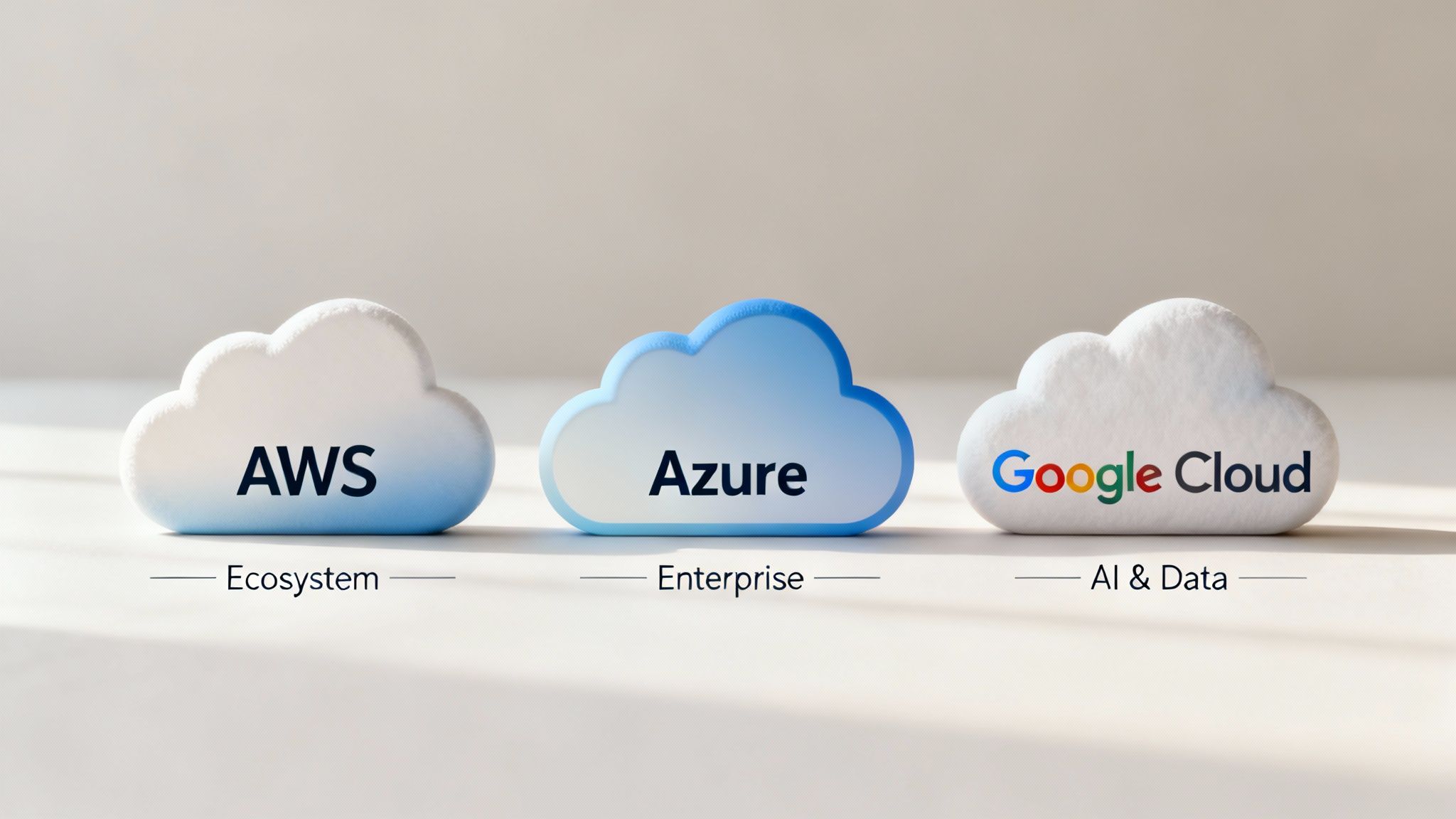
Alright, you've done the internal work and have a solid requirements document. Now the real fun begins: comparing the titans of the cloud world. The market is overwhelmingly led by three "hyperscalers": Amazon Web Services (AWS), Microsoft Azure, and Google Cloud Platform (GCP).
Forget about finding the one "best" provider. That doesn't exist. Your goal is to find the one whose strengths perfectly align with your business needs. Let's cut through the marketing fluff and look at where each one really shines, so you can figure out how to choose a cloud provider that's right for you.
AWS: The Established Market Leader
Amazon Web Services is the original player in this space, and its long history is its biggest advantage. They have the most comprehensive suite of services you can find, with a tool for just about any technical problem you can dream up. This sheer breadth makes it the go-to for many businesses, from nimble startups to massive enterprises.
Market share isn't just a vanity metric; it’s a strong signal of stability and a mature ecosystem. As of Q3 2025, AWS still holds a commanding lead with 30% of the global cloud market. After 19 years in the game, the platform offers an incredible 200+ services and has a presence in 31 geographic regions. You can dig deeper into these numbers in this cloud market landscape report.
What does that mean for you? A massive community, fantastic documentation, and a huge talent pool of engineers who already know their way around the platform. If you're building something complex and need a very specific, niche tool, odds are AWS has it.
Azure: The Enterprise and Hybrid Cloud Champion
Microsoft Azure has cemented its spot as a strong number two by doing what Microsoft does best: catering to the enterprise. If your business already runs on Microsoft products—think Windows Server, Office 365, or Active Directory—Azure offers an incredibly smooth path to the cloud. The native integration is a huge selling point that can save you a lot of headaches.
Where Azure has truly set itself apart is in the hybrid cloud space. Tools like Azure Arc are built for businesses that aren't going "all-in" on the public cloud. It gives you a single pane of glass to manage everything, whether it's on-prem, in Azure, or even on another cloud. If your strategy involves a mix of your own data centers and the cloud, Azure’s hybrid capabilities are second to none.
Pro Tip: Look at your existing tech stack and team skills. If your IT department is fluent in Microsoft, choosing Azure can drastically reduce the learning curve and speed up your entire migration. That translates to real savings in time and money.
Google Cloud: The Data and AI Powerhouse
Don't let its third-place position fool you; Google Cloud Platform (GCP) is a force to be reckoned with, especially in the areas its parent company, Google, built its empire on. GCP is an absolute beast when it comes to data analytics, machine learning (ML), and artificial intelligence (AI).
Services like BigQuery for data warehousing and Google Kubernetes Engine (GKE) for container management are widely considered the gold standard.
If your business model is built around processing enormous datasets or developing intelligent applications, GCP should be at the top of your list. Its global network is also top-tier, engineered for the kind of high-performance, low-latency demands of services like Google Search and YouTube. For a future built on data, aligning with GCP's strengths could be a game-changer.
Feature Comparison AWS vs Azure vs Google Cloud
While each provider offers core services like computing, storage, and networking, their specialized offerings and ecosystem integrations are where the real differences lie. This table gives you a high-level snapshot of their strengths.
| Feature/Service Area | AWS (Amazon Web Services) | Azure (Microsoft) | GCP (Google Cloud Platform) |
|---|---|---|---|
| Market Share | Leader. Longest track record and largest customer base. | Challenger. Strong #2, rapidly growing in enterprise. | Niche Player. Strong #3, focused on specific strengths. |
| Core Strengths | Broadest service portfolio, mature ecosystem, large community. | Seamless integration with Microsoft ecosystem, strong hybrid cloud. | Data analytics, machine learning, AI, and containerization (Kubernetes). |
| Compute | Amazon EC2 (highly customizable), Lambda (serverless). | Virtual Machines (strong Windows integration), Azure Functions. | Compute Engine, Google Kubernetes Engine (GKE) is best-in-class. |
| Databases | Aurora, DynamoDB, RDS. Widest variety of database types. | SQL Database, Cosmos DB. Excellent for Microsoft SQL Server workloads. | Cloud SQL, Spanner, Bigtable. Optimized for large-scale data. |
| Data & Analytics | Redshift, EMR, Kinesis. A very broad and mature toolset. | Synapse Analytics, HDInsight. Integrates well with Power BI. | BigQuery (serverless data warehouse) and Dataflow are standouts. |
| Best For… | Businesses needing maximum flexibility and the widest range of services. | Enterprises already invested in Microsoft software and hybrid strategies. | Data-intensive companies focused on AI/ML and modern applications. |
Ultimately, this is just a starting point. The "best" choice always comes back to your specific use case, existing technical skills, and long-term business goals. Use this comparison to narrow your focus before diving deeper into the specific services that matter most to you.
Understanding the True Cost of the Cloud
Let's be honest: cloud pricing can feel like a labyrinth. That advertised price for a virtual machine? It's rarely what you actually end up paying. Getting a handle on the real costs is one of the most critical parts of choosing a cloud provider. To build a realistic budget, you have to look past the sticker price and dig into all the variables that will shape your monthly bill.
This isn't just about crunching numbers; it's a core strategic decision. The money involved is staggering. Global spending on cloud infrastructure hit $107 billion in a single quarter (Q3 2025), a 28% jump from the previous year. The whole market is on track to hit $1 trillion by 2026.
When you consider that 33% of companies are already spending over $12 million a year on the cloud, it's clear that getting the cost wrong is a mistake you can't afford to make. You can dig deeper into this explosive growth with this in-depth market analysis on Statista.com.
Beyond Pay-As-You-Go
The default pay-as-you-go model gives you incredible flexibility, which is great for getting started. But for any consistent workload, it's almost always the most expensive route. To really get costs under control, you need to master the other pricing models on the table.
- Reserved Instances (RIs) & Savings Plans: This is your best friend for predictable workloads. You commit to a certain amount of usage for one or three years, and in return, you can get a massive discount—often up to 75%. Think of your primary web servers or core databases; they're perfect candidates.
- Spot Instances: Here's where you can find some incredible bargains. You're essentially bidding on spare, unused computing power, which can net you discounts up to 90%. The catch? The provider can pull the plug with very little notice. This makes them perfect for tasks that can be interrupted and restarted, like batch processing, data analysis, or a temporary test environment.
The real skill is in blending these models. A smart startup, for instance, might run its main application on Reserved Instances for that rock-solid stability and predictable cost. At the same time, they could use Spot Instances for all their development and testing, saving a ton of cash where uptime isn't critical.
Uncovering Hidden Cloud Costs
What really blows up a cloud budget are the costs you never saw coming. Every provider has a pricing calculator, and they're a decent place to start. But they don't always do a great job of highlighting the "gotchas" that can send your bill through the roof.
If there's one surprise that hits almost everyone, it's data egress fees. It costs next to nothing to push your data into the cloud. But you get charged every single time that data is transferred out to the public internet. If you're a media company serving video streams, this can quickly become one of your biggest operating expenses.
Keep a sharp eye out for these common hidden costs:
- Data Egress: The fees for moving data out of the provider’s network.
- Premium Support Plans: Basic support is often just that—basic. If you need a fast response for a business-critical issue, you'll be paying a premium for it.
- Monitoring and Logging: You absolutely need advanced monitoring, alerting, and log storage for any production system, but these are almost always add-on costs.
- Managed Services: Offloading the headache of running a database to your provider is a huge time-saver. But that convenience comes at a higher price than just running it yourself on a standard virtual machine.
By getting into the weeds on these details before you commit, you can build a financial forecast that reflects reality. It’s the key to avoiding that dreaded bill shock and making sure your move to the cloud is a sustainable one.
Evaluating Security, Compliance, and Support
When you sign up with a cloud provider, you're doing more than just renting server space. You're handing over the keys to your most valuable asset: your data. This is why security, compliance, and support aren't just checklist items—they're the foundation of the entire relationship.
Think of it this way: cloud security operates on a shared responsibility model. The provider’s job is to secure the actual cloud infrastructure—the physical data centers, the servers, the network. But you are responsible for everything in the cloud. That means you handle configuring firewalls, managing who gets access, and encrypting your data.
Verifying Certifications and Tools
Any provider can talk a big game about security, but you need proof. This is where third-party compliance certifications are essential, as they verify that a provider meets globally recognized standards.
Depending on your industry, you'll want to see evidence of certifications like:
- ISO 27001: The gold standard for information security management.
- SOC 2 Type II: A deep audit of their controls for security, availability, and confidentiality.
- HIPAA: A must-have if you work with any kind of protected health information (PHI).
- GDPR: Absolutely critical if you have customers in the European Union.
But certifications are just the start. Look at the practical, hands-on security tools they give you. A good provider will offer built-in defenses like fine-grained Identity and Access Management (IAM), DDoS protection, and sophisticated threat detection. This is where things can get complex, which is why many businesses turn to managed IT and cybersecurity services to get their cloud environment configured securely from day one.
Key takeaway: A provider being HIPAA certified doesn't mean your application is automatically compliant. It just means they give you the compliant environment and tools. It's still on you to build your solution correctly.
Don't Overlook Technical Support
Everyone ignores technical support… until a critical system goes down at 2 AM. Vetting a provider's support options before you're in a crisis is one of the most crucial parts of this process.
Get straight answers to these questions:
- What kind of support is included in the base price?
- For paid plans, what are the guaranteed response times for a major outage?
- How much does premium support actually cost? Is it a flat rate or a percentage of your bill?
That last point is a big one. A provider might look cheap on the surface, but if their top-tier support costs an extra 10% of your monthly spend, your total cost can skyrocket. Make sure the support plan you choose matches your team's technical skills and how critical your applications are.
Making Your Final Decision and Planning Ahead
You've done the homework and weighed the options. Now it's time to pull all that research together and make a final, confident choice. The best way to do this is to take the emotion out of it and rely on the data you’ve gathered. A structured approach ensures your decision lines up perfectly with the business needs you identified at the very beginning.
A simple scoring matrix can be a game-changer here. Just list your must-have criteria—things like cost, security tools, support quality, and performance—in a column. Then, put your top two or three providers across the top. Go down the list and score each one, maybe on a simple scale of 1-5, for every single item. When you tally up the scores, you'll have a clear, objective winner based on what truly matters to your business.
Test Before You Invest
Even if one provider looks perfect on paper, don't just sign the contract and start moving everything over. That's a recipe for disaster. Instead, you need to kick the tires with a proof-of-concept (PoC) or a small pilot project.
Pick a single, non-critical application and get it running on your top choice's platform. This is your low-risk test drive, and it will answer some huge questions that a sales pitch never can:
- How does this thing actually perform with a real workload?
- Can my team navigate the management console without pulling their hair out?
- When we hit a snag and call support, do we get real help, and how fast?
This hands-on experience is often the deciding factor. It confirms whether the reality lives up to the marketing hype. What you learn during a PoC can also help you build a much smarter migration plan, especially if you decide to bring in professional cloud security management services to help.
The decision tree below gives you a great visual for how factors like security, compliance, and support all have to work together in your evaluation.
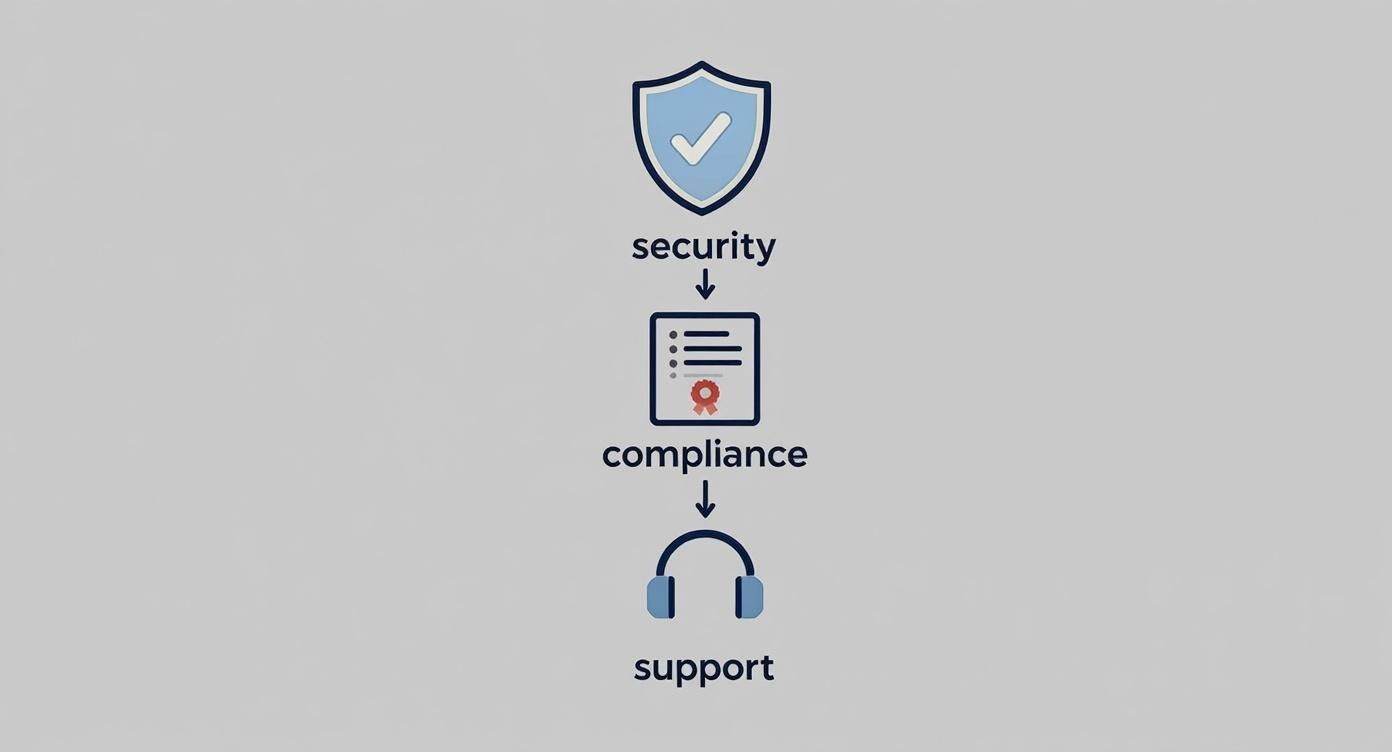
It's a solid reminder that you're not just buying a server; you're choosing a platform and the operational ecosystem that comes with it.
Long-Term Vision and Avoiding Lock-In
Picking a cloud provider is a long-term play. You're looking for a partner whose own roadmap aligns with where you want to take your business. Think beyond just raw computing power. Each of the big players has its strengths: AWS is the undisputed king of IaaS, Azure is a natural fit for businesses built on the Microsoft stack, and Google Cloud is a beast when it comes to AI and data analytics. You can dig deeper into these market specializations on cloudzero.com.
Your final decision isn't just about the technology of today but about betting on a partner who will enable your business's vision for tomorrow.
As you make this choice, always keep flexibility in mind. You want to avoid vendor lock-in at all costs. You can do this by building on open-source technologies like Kubernetes whenever possible. For your most critical workloads, you might even consider a multi-cloud strategy. This approach keeps you agile and ensures you can pivot when your needs change or a better technology comes along.
Frequently Asked Questions
Is It a Mistake to Choose a Smaller Cloud Provider?
Absolutely not. It's easy to get caught up in the gravity of the "big three" cloud providers, but sometimes the best fit is a smaller, more specialized player. Niche providers can often outshine the giants in specific areas, like offering better pricing for high-performance computing or providing raw bare-metal servers.
Think of it this way: if a smaller provider’s services are a perfect match for your unique workload and they offer more hands-on, personalized support, they could be the smarter choice. The critical part is doing your due diligence—really dig into their financial stability, security track record, and how long they've been in the game before you sign on the dotted line.
How Important Is Vendor Lock-In?
Vendor lock-in is a huge deal and one of the biggest long-term risks you'll face. It's that tricky situation where your entire operation becomes so entangled with one provider's proprietary tools that leaving becomes a technical and financial nightmare.
The best defense is a good offense. By building your applications on open-source technologies like Kubernetes and PostgreSQL from the start, you maintain control. Thinking about portability on day one isn't just a technical detail; it's a strategic move that gives you flexibility and bargaining power later on.
Can I Switch Cloud Providers Later?
You can, but it's almost never as simple or cheap as you'd hope. Migrating from one cloud to another is a massive undertaking. We're talking about moving huge datasets, re-architecting applications, and getting your team up to speed on a completely different ecosystem.
The more you rely on a provider's unique, proprietary services, the harder and more expensive the move will be. This is exactly why it pays to be thoughtful and deliberate with your initial choice. A little extra planning upfront can save you a world of pain down the road.
Ready to secure your cloud environment from day one? The experts at Defend IT Services create customized security roadmaps that protect your data and ensure compliance. Let us help you manage your cloud securely and efficiently. Learn more about our cloud security services.