

Think of it this way: a standard security guard can watch over an office building, but you'd want a specialized team with laser grids and pressure plates to protect a bank vault. That's the difference between regular IT and financial service IT support. One handles everyday tech issues; the other is built from the ground up to defend high-stakes financial data and navigate a labyrinth of complex regulations.
Why Specialized IT Is Non-Negotiable In Finance

In the world of finance, technology isn't just a convenience—it's the bedrock of your business. It’s the foundation of client trust, operational integrity, and the security of every transaction. Generic IT support simply can't keep up with the unique pressures and threats of this industry. The stakes are just too high for a one-size-fits-all solution.
Financial service IT support is specifically designed to tackle challenges that other sectors rarely encounter. It’s about so much more than fixing a stubborn printer or resetting a forgotten password. The real work is in creating a hardened digital environment that can withstand constant attack while also satisfying an ever-growing list of legal and regulatory demands.
The Core Differences
The biggest distinction is the proactive, security-first mindset. Instead of just reacting to problems as they pop up, a specialized provider is always anticipating the next threat. This strategic focus is absolutely essential for protecting sensitive client data, ensuring your operations never skip a beat, and maintaining a spotless reputation.
To see just how different the approach is, let's compare them side-by-side.
Standard IT vs. Financial Service IT Support
| Feature | Standard IT Support | Financial Service IT Support |
|---|---|---|
| Primary Goal | Maintain system uptime and fix user issues. | Protect sensitive data, ensure compliance, and manage risk. |
| Security Focus | General defense (antivirus, firewall). | Multi-layered, advanced security (threat hunting, SIEM). |
| Compliance | Basic data privacy awareness. | Deep expertise in PCI DSS, GLBA, SOX, and state laws. |
| Data Backup | Standard backups for business continuity. | Immutable backups and audited disaster recovery plans. |
| Monitoring | Reactive monitoring for system failures. | Proactive 24/7 monitoring for security incidents. |
| Vendor Management | General oversight. | Rigorous vetting to ensure third-party compliance. |
As you can see, this is a field driven by immense responsibility, where a single oversight can lead to catastrophic consequences. The proof is in the spending. Global technology investment is on track to hit $4.9 trillion by 2025, and the financial services industry is a huge part of that push. Firms are pouring money into modernizing their systems and defending against a constant barrage of security threats.
Financial IT isn't just about keeping the lights on; it's about building a digital fortress. It ensures that every transaction, every client record, and every communication is protected by a framework built on security and compliance.
This specialized approach is fundamental to every part of a modern financial firm's operations. The importance of cybersecurity for growing businesses cannot be overstated, especially when client trust is your most valuable asset. It's a critical investment in your firm's resilience and its ability to thrive securely.
The Core Components of a Secure IT Framework

A truly resilient IT strategy for a financial firm isn't about buying a single piece of software. It’s about weaving together a tapestry of interconnected services that protect you from every angle.
Think of it like securing a medieval castle. You need more than just a strong wall. You need vigilant watchtowers, a deep moat, and guards at every gate. In the digital world, these defenses are the core components that create a protective barrier around your firm’s most valuable asset: your data.
Each layer works in concert with the others to shut down threats, ensure you can keep operating no matter what, and build a secure foundation for your business. Let's break down these essential pillars of modern financial service IT support.
Proactive 24/7 Network Monitoring
Your first line of defense is constant vigilance. Proactive 24/7 monitoring acts as a sleepless digital watchdog, constantly scanning your network for anything out of the ordinary. This isn't the old "wait for it to break, then fix it" model. This is about actively hunting for the subtle clues that could signal a breach in progress.
It means a team of security experts is analyzing your network traffic, system logs, and access patterns in real-time. If an unauthorized device suddenly connects or a large chunk of data starts moving at 3 AM, they can step in immediately—long before it becomes a catastrophe.
Robust Endpoint Security
Every single device connected to your network is an endpoint. That includes a loan officer's laptop, a wealth manager's tablet, and even the receptionist's desktop. Each one is a potential entry point for an attacker.
Robust endpoint security is like putting a dedicated, highly trained guard at every door and window of your digital fortress. This goes far beyond basic antivirus. A proper financial IT framework deploys advanced tools that can:
- Prevent Malware: Actively block ransomware, spyware, and other malicious code before it can even run.
- Control Access: Enforce rules so only authorized users and applications can touch sensitive data on each device.
- Detect Threats: Identify and immediately isolate a compromised machine before it can infect the rest of the network.
This is especially critical for firms with remote or traveling employees, ensuring your security follows your team wherever they work.
A secure perimeter is no longer enough. With financial data being accessed from anywhere, the endpoint has become the new battleground, making hardened device security an absolute necessity.
A foundational element here is having solid data governance strategies in banking, which provide the rules for how data is managed and protected at every level, including on individual devices.
Continuous Vulnerability Management
Hackers don't always need to break down the door. Sometimes, they just stroll through one that was accidentally left unlocked. In the tech world, these unlocked doors are software vulnerabilities—flaws in code that can be exploited to gain access.
Continuous vulnerability management is the ongoing process of finding and locking these doors before the bad guys do. This isn't a one-time scan; it's a constant cycle of identifying, assessing, and patching weaknesses across your entire IT environment. A dedicated financial IT provider automates this, ensuring critical security updates are applied the moment they're available, shrinking the window of opportunity for cybercriminals.
Fortified Cloud Security and Management
As financial firms embrace the cloud, securing that environment has become a top priority. Cloud security isn't a default feature; it requires a specialized set of policies, controls, and technologies designed to protect data, applications, and infrastructure hosted with providers like AWS or Azure.
Effective cloud management ensures your setup is not only secure but also optimized for performance and cost. For a closer look at the advantages for local businesses, check out our guide on why every San Antonio business needs managed IT and cybersecurity services.
Comprehensive Backup and Disaster Recovery
Let’s talk about the worst-case scenario: a successful ransomware attack, a fire in the server room, or a critical hardware failure. A comprehensive backup and disaster recovery (BDR) plan is your firm's ultimate safety net. It’s what separates a minor disruption from a business-ending event.
A modern BDR strategy is more than just copying files to an external drive. It means creating immutable—or unchangeable—backups that are shielded from ransomware, combined with a detailed and tested plan to get your operations back online quickly. The goal is to minimize downtime and data loss so you can get back to serving your clients without skipping a beat.
Meeting Demanding Financial Compliance Requirements
In the financial world, compliance isn’t just a "best practice"—it’s everything. It’s the foundation of trust, the price of admission to the market, and the key to your firm’s survival. Get it wrong, and you’re looking at crippling fines, a damaged reputation that’s hard to rebuild, and even legal trouble. This is precisely where specialized financial service IT support proves its worth, acting less like a tech vendor and more like an essential risk management partner.
An experienced IT provider doesn’t just patch systems to meet a compliance mandate after the fact. They build your entire IT infrastructure to be compliant from the ground up. They get that regulations aren't just a checklist; they're principles that have to be woven into the very fabric of your daily work. This proactive approach means you’re always ready for an audit, protecting the business from costly violations that could put everything at risk.
Navigating the Alphabet Soup of Regulations
If you're not steeped in the industry, the list of acronyms can feel like a foreign language. Each one governs a different piece of the puzzle—from how you handle data to how you report financials. A skilled IT partner is your translator and guide, making sure your technology and workflows are perfectly aligned with these non-negotiable standards.
Let’s quickly demystify the big ones:
- Payment Card Industry Data Security Standard (PCI DSS): Think of this as the digital equivalent of an armored truck. It lays out the strict rules for how you must handle, store, and process credit card information to shut down fraud. If your firm takes card payments, this is mandatory. No exceptions.
- Gramm-Leach-Bliley Act (GLBA): This one is all about protecting your clients' personal financial information. The GLBA demands that you tell customers how you share their info and, more importantly, that you have robust safeguards in place to protect that sensitive data from any foreseeable threats.
- Sarbanes-Oxley Act (SOX): Born out of the ashes of major corporate accounting scandals, SOX is laser-focused on the integrity of financial reporting. For your IT team, that means proving that all financial data is secure, accurate, and always available for public disclosures.
This diagram shows how these critical standards work together to create a secure financial environment.
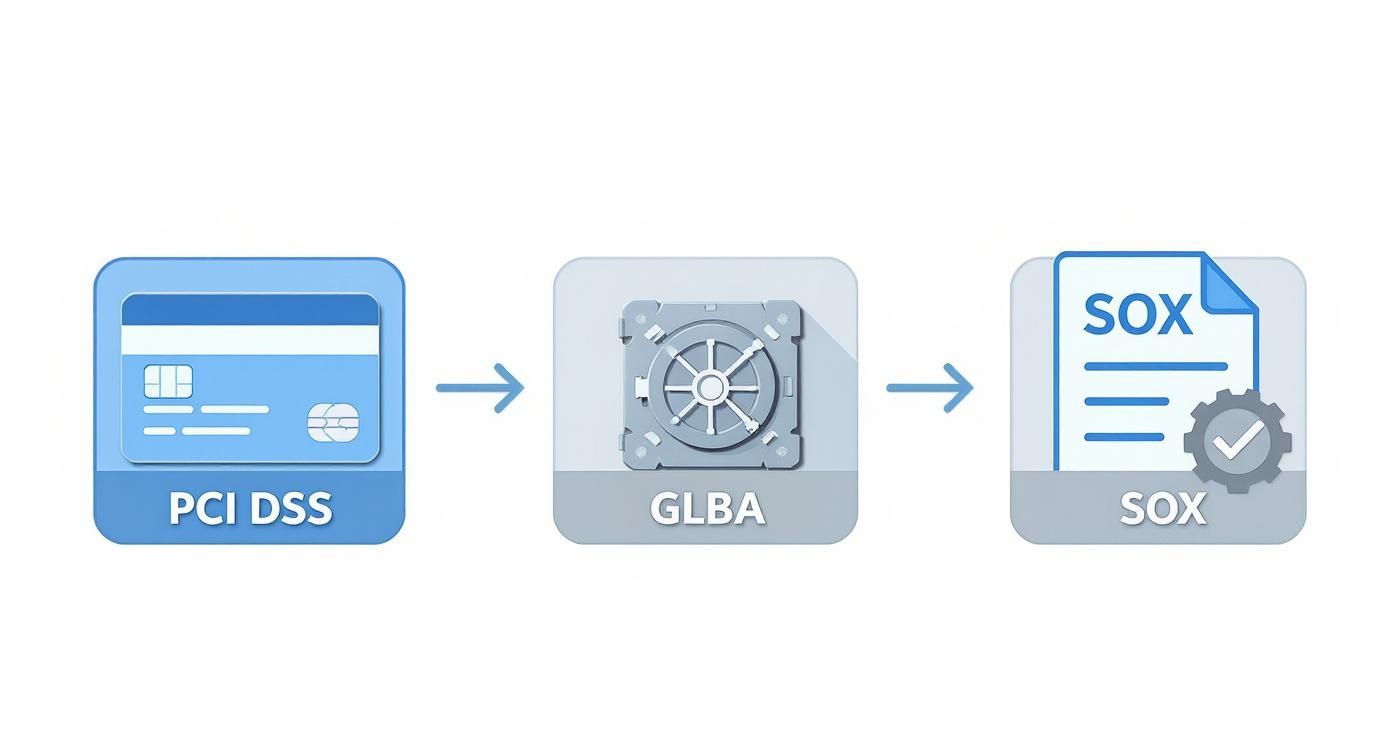
Each regulation tackles a specific risk, from payment fraud and data privacy to corporate accountability, forming a comprehensive security net for your business.
Beyond the Big Three: State Rules and Audit Preparedness
Don't make the mistake of thinking compliance ends at the federal level. Many states, like California with its CCPA or New York with the SHIELD Act, have their own tough data privacy laws. A top-tier financial IT provider is always watching these local regulations, tweaking your security posture to keep you compliant no matter where you do business.
This constant state of readiness is what makes audits a breeze. An audit should be a simple validation of the strong controls you already have, not a mad dash to fix a dozen problems you just discovered.
A proactive IT partner turns compliance from a headache into a competitive edge. When your systems are inherently secure and auditable, you’re sending a powerful message of trust and transparency that both clients and regulators want to see.
This means keeping meticulous logs, being able to generate compliance reports on demand, and having a well-documented incident response plan ready to go at a moment's notice.
Building a Foundation of Trust with Frameworks
To juggle all these different requirements, expert IT providers don't reinvent the wheel. They align their services with established security frameworks. If you want to dig deeper into a standard trusted by many, check out this guide on What Is SOC 2 Compliance, which explains how organizations should manage customer data based on core principles like security, privacy, and availability.
Adopting a framework like this gives you a structured, repeatable process for proving your commitment to security. It’s a continuous cycle: assess your risks, put the right controls in place, and then monitor them to make sure they’re working.
This methodical approach is far more effective than trying to tackle each regulation one by one. By building a secure IT foundation based on industry-wide best practices, you create an environment that naturally satisfies the core demands of PCI DSS, GLBA, SOX, and more. In the end, this strategy doesn't just keep regulators off your back—it protects your clients, your reputation, and your bottom line.
Building Your IT Security Roadmap

Trying to implement a comprehensive IT strategy can feel like a monumental task, especially when you're dealing with the high-stakes world of finance. But it doesn't have to be. With a structured approach, you can break this complex challenge down into a series of clear, manageable steps. Working with a specialist in financial service IT support gives you a guide who knows the terrain and can build a solid roadmap to shore up your security and compliance.
Think of it like building a custom home. You wouldn't just start pouring concrete without a detailed blueprint. First, you'd get the land surveyed to understand the challenges. Then, an architect designs a plan, and contractors build it out in logical phases. An IT security roadmap follows that same proven process for your digital infrastructure.
Phase 1: Assessment and Gap Analysis
The whole process kicks off with a deep dive into your current IT environment. This is the survey phase. Your IT partner acts like a digital detective, meticulously examining every part of your network, devices, software, and existing security protocols. They’re not just looking for the obvious problems; they're hunting for the subtle vulnerabilities that attackers love to exploit.
This thorough review compares your current setup against both industry best practices and, just as importantly, the specific regulations your firm is required to meet. The end result is a detailed gap analysis report. This document gives you the unvarnished truth—it shows where your defenses are solid and, more importantly, where you're exposed. It becomes the factual foundation for every decision that comes next.
Phase 2: Strategic Planning
With the gap analysis in hand, it's time to create the blueprint. This isn't just about making a shopping list for new software. It’s a strategic plan that lines up technology with your actual business goals and compliance duties. Your IT partner will work with you to prioritize the risks found in phase one, tackling the most critical threats first.
This collaborative planning stage is all about answering the tough questions:
- What are the most urgent security gaps that we need to plug right now?
- Which solutions will give us the biggest bang for our buck in terms of compliance and risk reduction?
- How can we achieve our goals without breaking the bank or derailing our operations?
The outcome is a clear, actionable IT roadmap. It outlines specific projects, defines what success looks like, and sets a realistic timeline for getting everything done. This makes sure everyone is on the same page and every dollar is spent wisely.
A well-defined IT roadmap does more than just fix problems; it provides a predictable, strategic path to a stronger and more resilient business. It turns reactive firefighting into proactive risk management.
Phase 3: Phased Implementation
Now, we build. To avoid disrupting your business or overwhelming your team, the roadmap is rolled out in logical, manageable phases. It’s like renovating one room at a time instead of gutting the whole house at once. Usually, critical security foundations like multi-factor authentication or advanced endpoint protection are put in place first.
Each phase is its own mini-project with clear goals. For instance, Phase One might focus on locking down your network perimeter and deploying a new backup system. Phase Two could then tackle migrating to a secure cloud environment. This phased approach guarantees a smooth, controlled transition and gives your team time to get comfortable with new tools and procedures.
Phase 4: Continuous Optimization
Let's be clear: your security journey is never truly "done." The threat landscape is always shifting, and regulations get updated all the time. The final—and ongoing—phase of your roadmap is a continuous cycle of monitoring, testing, and improving.
This means regular security check-ups, vulnerability scans, and reviews of your compliance status. Your financial IT support partner will provide you with straightforward reports and recommend adjustments to keep your defenses sharp. This proactive fine-tuning is what ensures your IT infrastructure remains a powerful asset that protects your firm, your clients, and your reputation for years to come.
Here's a quick look at how these phases translate into a practical plan for a small or mid-sized business:
IT Implementation Roadmap for SMBs
This table breaks down the typical journey of implementing a new IT support strategy, from initial discovery to long-term management.
| Phase | Objective | Key Deliverables |
|---|---|---|
| 1. Discovery & Assessment | Understand the current IT state and identify vulnerabilities. | Complete network audit, device inventory, gap analysis report. |
| 2. Strategic Planning | Develop a prioritized, budget-conscious action plan. | Formal IT security roadmap, project timeline, success metrics. |
| 3. Foundational Security | Implement core security controls to address immediate risks. | Deployed MFA, endpoint protection, and managed firewall. |
| 4. Implementation & Migration | Execute key projects like cloud migration or system upgrades. | New systems online, data successfully migrated, user training. |
| 5. Ongoing Optimization | Maintain security posture and adapt to new threats. | Regular security reports, quarterly business reviews, updated policies. |
By following a structured roadmap like this, even smaller firms can achieve an enterprise-level security and compliance posture without getting lost in the complexity.
How to Choose the Right IT Partner
Picking an IT provider is one of the biggest decisions your firm will ever make. You aren't just hiring a vendor; you're handing over the keys to your digital kingdom. To get this right, you have to look past the slick sales pitch and dig into the core competencies that actually matter in the high-stakes world of financial service IT support.
A cheap contract means nothing if your IT partner can’t get your data back after a ransomware attack or help you navigate a surprise regulatory audit. Your decision has to be based on proven expertise, transparent processes, and rock-solid reliability.
This means you need to ask tough questions and demand clear, specific answers. Vague promises won't protect your clients' data, so your evaluation has to be methodical and unflinching.
Scrutinize Service Level Agreements
Think of a Service Level Agreement (SLA) as a legally binding promise, not just another document. It lays out the specific, measurable standards your IT provider is obligated to meet. If you see a generic SLA promising "fast response times," that's a huge red flag. You need hard numbers.
When you're reviewing an SLA, zoom in on these details:
- Guaranteed Response Time: How quickly will they actually acknowledge a critical issue, like a server outage? Don't settle for anything less than a guarantee of 15 minutes or less for urgent problems.
- Guaranteed Resolution Time: Beyond just responding, how long will it take them to fix that critical issue? This is a key metric that separates the pros from the amateurs.
- System Uptime Guarantee: What percentage of the time do they guarantee your critical systems will be up and running? The goal here should be 99.9% or higher.
- Penalties for Failure: What's on the line if they don't deliver? A strong SLA includes financial credits or other penalties, showing they have real skin in the game.
Verify Their Incident Response Plan
Every single financial firm has to plan for a worst-case scenario. When vetting a potential IT partner, ask them to walk you through their incident response (IR) plan, step by step. This isn't a theoretical drill—you need to know their exact process for containing and resolving a security breach.
An IT partner without a detailed, tested incident response plan is like a fire department without a truck. When disaster strikes, you need a team with a clear plan of action, not one figuring it out on the fly.
Here are the questions you should be asking:
- What are the first three things you do the moment you discover a potential data breach?
- How do you isolate compromised systems to stop the threat from spreading across our network?
- Walk me through your process for data recovery and getting our business back online.
- How do you manage communications with our leadership team and, if necessary, regulatory bodies?
You're looking for confident, detailed, and immediate answers. Any hesitation is a major warning sign.
Confirm Industry Expertise and Certifications
General IT knowledge just doesn't cut it. The financial services industry is exploding, with venture capital funding in the Americas hitting $23.4 billion in 2024. This massive growth is creating intense, highly specific IT demands across the more than 12,000 fintech companies in North America. If you want to dive deeper into this trend, check out the latest fintech sector growth statistics. Your IT partner has to live and breathe this environment.
Look for a provider with a proven track record in your sector. Ask to see case studies or speak with references from other financial firms they support. You should also ask about their team’s certifications, like the CISSP (Certified Information Systems Security Professional) or CompTIA Security+, which prove a real commitment to security.
For firms in Texas, having a partner who understands the local business landscape is a huge advantage. You can learn more about how San Antonio businesses trust DefendIT Services for cybersecurity and IT solutions. Ultimately, choosing the right partner is the single best thing you can do to protect your firm's security, compliance, and future.
Your Blueprint for Secure Financial Operations
Think of specialized financial IT support less as an expense and more as a strategic investment in your firm's future. It's about building resilience, protecting your reputation, and paving the way for growth. As we've covered, the right partner does far more than just fix computers when they break. They build a secure digital foundation from the ground up, one designed to protect sensitive client data and ensure you're always on the right side of financial regulations.
The most critical shift you can make is moving from a reactive, break-fix mindset to a proactive, security-first approach. A general IT provider keeps the lights on; a specialist in financial service it support actively manages and reduces your risk. They get that a single vulnerability or a minor compliance oversight can snowball into a disaster for your firm and your clients.
The real goal here is to turn your IT infrastructure from a potential liability into a genuine competitive advantage. When your operations are secure and compliant, you can stop worrying about your digital backbone and focus entirely on building client relationships and growing your business.
Taking the Next Step
You now have a blueprint to move forward. The first step is to take a hard, honest look at your current defenses. Are you really prepared for an audit at a moment's notice? Have you actually tested your data recovery plan to see if it works? Does your IT strategy just maintain the status quo, or does it actively make your firm safer?
Answering these questions will shine a light on where your weak spots are and show you a clear path forward.
The final piece of the puzzle is finding a partner who can help you build that secure and compliant operation. Look for a provider with a proven track record in the financial sector—one who truly understands the unique pressures you face every day. Your firm's security is simply too important to leave to chance. By choosing a partner dedicated to proactive defense and strict compliance, you're not just buying a service; you're investing in peace of mind and securing your firm's future.
Frequently Asked Questions
It's natural to have questions when you're thinking about bringing in specialized IT support for your financial firm. Here are some straightforward answers to the questions we hear most often, covering everything from cost to critical security measures.
What Does Financial Service IT Support Typically Cost?
There's no single price tag for this kind of specialized support—it really comes down to your firm's specific situation. The final cost depends on factors like the number of people and devices on your network, how complex your setup is, and which specific regulations you need to follow (like PCI DSS or GLBA).
Most IT partners use a simple monthly fee based on each user or device. This makes budgeting predictable and allows the service to grow with you. While it might look more expensive on paper than a simple "break-fix" service, you're paying for proactive security, constant monitoring, and compliance management. That investment is designed to prevent a data breach or regulatory fine, which would cost you far, far more in the long run.
Can Small Firms Afford and Benefit From This Service?
Yes, absolutely. In fact, small and midsize firms often get the biggest bang for their buck. For a smaller business, trying to hire an in-house team with the right mix of cybersecurity skills and deep financial compliance knowledge is usually just not feasible from a cost perspective.
When you outsource, you get access to a full team of seasoned experts for a predictable monthly fee—often less than the salary of a single senior security engineer. This really levels the playing field, giving smaller advisory firms, local credit unions, and independent brokerages the kind of rock-solid security that was once only available to large enterprises.
For an SMB, specialized IT isn't an expense—it's a force multiplier. It provides the security and compliance foundation needed to compete with larger institutions and build lasting client trust.
What Is the Single Most Critical Security Measure?
If we had to pick just one, it would be a powerful duo: multi-factor authentication (MFA) paired with a solid backup and disaster recovery (BDR) plan. Think of MFA as the digital deadbolt on your front door. Even if a cybercriminal steals a password, MFA stops them in their tracks. We know from research that it can block over 99.9% of attacks that rely on stolen credentials.
But since no defense is truly impenetrable, a well-tested BDR plan is your ultimate safety net. It’s what ensures that if the worst-case scenario happens—like a ransomware attack successfully locks your files—you can restore your data and get back to business quickly. This minimizes the financial and reputational damage that downtime can cause.
Ready to secure your firm with expert financial service IT support? Defend IT Services provides the proactive security, compliance expertise, and responsive local support you need to operate with confidence. Contact us today for a free consultation.