
In an era where a single data breach can cripple a small or midsize business, effective data protection is no longer optional. For organizations handling sensitive information, especially in regulated sectors like healthcare (HIPAA) or finance (PCI-DSS), a breach can lead to severe financial penalties, operational disruption, and a permanent loss of customer trust. Simply flipping the switch on encryption is not a complete strategy. The real security lies in the details: the algorithms you choose, how you manage cryptographic keys, and the protocols you enforce across your network.
This guide is designed to be a practical, actionable resource. We will cut through the technical jargon to provide a prioritized roundup of 10 essential data encryption best practices. You will learn not just what to do, but how to do it, with a focus on real-world implementation for protecting data both at rest and in transit.
We will cover critical topics including:
- Selecting strong, modern encryption algorithms and configurations.
- Implementing robust key management lifecycles to prevent unauthorized access.
- Securing data across endpoints, cloud environments, and backups.
- Establishing monitoring and auditing procedures to maintain compliance and detect threats.
By the end of this article, you will have a clear roadmap to transform your encryption from a simple checkbox item into a powerful, strategic defense that safeguards your organization’s most valuable assets.
1. Use Strong Encryption Algorithms
The foundation of any robust data protection strategy is the selection of strong, well-vetted encryption algorithms. These are the mathematical engines that transform sensitive plaintext into unreadable ciphertext. Choosing a powerful algorithm is the first critical step in implementing data encryption best practices, ensuring your data is computationally infeasible for unauthorized parties to decipher.
A strong algorithm has withstood years of public scrutiny and rigorous analysis by the global cryptographic community. This peer-review process is essential for identifying and mitigating vulnerabilities that could otherwise be exploited. For example, the U.S. government relies on the Advanced Encryption Standard (AES) with a 256-bit key (AES-256) to protect classified information up to the Top Secret level, showcasing its proven resilience.

Why It's a Top Priority
Using a weak or outdated algorithm like DES or RC4 is equivalent to locking a bank vault with a suitcase lock. Modern computing power can break these older standards in minutes, rendering them useless for protecting sensitive financial, healthcare, or client data. Strong algorithms, by contrast, are designed to resist brute-force attacks even from the most powerful supercomputers for the foreseeable future. To effectively use strong algorithms, a foundational understanding of encryption types is crucial. For instance, you can dive deeper into understanding symmetric and asymmetric key encryption.
Practical Implementation Steps
Follow these actionable guidelines to ensure your algorithm choices meet modern security standards:
- Standardize on AES-256: For symmetric encryption (data at rest), AES-256 is the industry gold standard. It’s used in tools like BitLocker and FileVault for full-disk encryption.
- Utilize Modern Suites for Data in Transit: For data in transit, protocols like TLS 1.3 use authenticated encryption algorithms such as AES-256-GCM or ChaCha20-Poly1305, which encrypt data and verify its integrity simultaneously.
- Leverage Established Libraries: Never attempt to write your own encryption code. Instead, use well-maintained, audited cryptographic libraries like OpenSSL, BoringSSL, or libsodium.
- Keep Libraries Updated: Regularly apply security patches to your cryptographic libraries to protect against newly discovered vulnerabilities.
2. Implement End-to-End Encryption
Beyond just encrypting data in transit or at rest, end-to-end encryption (E2EE) provides a comprehensive security model where data is protected from its origin all the way to its destination. This method ensures that only the sender and the intended recipient have the keys to decrypt the message. Service providers, network administrators, and even malicious actors who intercept the data cannot access its plaintext content.
Implementing E2EE is a critical data encryption best practice for communications, as it closes the gap where data might be temporarily decrypted on a server. For industries like healthcare and finance, this prevents any intermediary from accessing sensitive client or patient information. Popular platforms like the Signal messaging app, which uses the robust Signal Protocol, and ProtonMail for secure email, have built their reputations on providing true E2EE, guaranteeing user privacy at the core of their architecture.
Why It's a Top Priority
Standard transport layer encryption (like TLS) secures the channel between a client and a server, but the server itself can see the plaintext data. If that server is compromised, all data becomes vulnerable. E2EE eliminates this risk by making the server a "zero-knowledge" conduit, meaning it facilitates the transfer of encrypted data without ever being able to read it. This is the highest standard for confidential communications, essential for protecting trade secrets, attorney-client privilege, and protected health information (PHI).
Practical Implementation Steps
Follow these actionable guidelines to effectively implement end-to-end encryption:
- Adopt Proven Protocols: Instead of creating a custom E2EE system, leverage established, peer-reviewed protocols like the Signal Protocol or the Noise Protocol Framework. These have been battle-tested and are considered the gold standard.
- Implement Perfect Forward Secrecy (PFS): Use algorithms that provide PFS, where each session has a unique, temporary key. This ensures that even if a long-term key is compromised, past communications remain secure.
- Verify Recipient Identity: Before exchanging keys, implement a robust mechanism to verify the identity of the recipient to prevent man-in-the-middle (MITM) attacks. This can be done through QR code scanning or safety number comparisons.
- Communicate Security Status to Users: Clearly indicate to users when their communications are end-to-end encrypted. This transparency builds trust and helps them understand the level of protection they have.
3. Enforce Proper Key Management Practices
If strong algorithms are the lock, then encryption keys are the only way to open it. Without robust key management, even the most powerful encryption is rendered useless. Proper key management involves overseeing the entire lifecycle of a cryptographic key, from secure generation and storage to timely rotation and eventual destruction. This discipline ensures that the keys themselves do not become the weakest link in your data protection strategy.
A compromised key provides an attacker with a master pass to all the data it protects, completely bypassing the encryption. Therefore, managing keys with the same level of security as the data itself is a non-negotiable aspect of data encryption best practices. Leading organizations, from financial institutions using Thales Hardware Security Modules (HSMs) to cloud-native businesses leveraging AWS Key Management Service (KMS), build their security posture on a foundation of rigorous key lifecycle management.

Why It's a Top Priority
Neglecting key management is like leaving the key to the vault taped to the door. An attacker who gains access to your keys can decrypt sensitive information at will, leading to catastrophic data breaches, regulatory fines, and loss of customer trust. Properly managing this lifecycle is particularly critical for SMBs and regulated entities that may lack dedicated cryptographic expertise. For these organizations, navigating the complexities of key management often underscores the value of expert guidance, and you can explore how managed IT and cybersecurity services provide this specialized support.
Practical Implementation Steps
Follow these actionable guidelines to establish a secure key management framework based on industry standards like NIST SP 800-57:
- Centralize Key Management: Use a dedicated Key Management Service (KMS) like AWS KMS or Azure Key Vault instead of managing keys within application code. This centralizes control and auditing.
- Never Hardcode Keys: Never embed encryption keys directly in source code, configuration files, or scripts. This is a common and easily exploitable vulnerability.
- Automate Key Rotation: Implement a policy for automatic key rotation, typically on an annual basis or more frequently for high-risk data. This limits the "blast radius" if a key is ever compromised.
- Use Hardware Security Modules (HSMs): For the most critical keys, use a FIPS 140-2 validated HSM. HSMs provide a tamper-resistant hardware environment for key generation, storage, and cryptographic operations.
- Implement Strict Access Controls: Apply the principle of least privilege to key access. Only authorized users and services should be able to request or use encryption keys.
4. Use Authenticated Encryption with Associated Data (AEAD)
Standard encryption provides confidentiality, ensuring only authorized parties can read the data. However, it doesn't inherently protect against an attacker modifying the encrypted data while it's in transit or at rest. Authenticated Encryption with Associated Data (AEAD) solves this by combining data confidentiality with data integrity and authenticity in a single, secure cryptographic operation.
AEAD modes like AES-GCM and ChaCha20-Poly1305 encrypt the sensitive data and simultaneously generate an authentication tag. This tag acts as a unique signature for the message. Upon receipt, the decryption process will fail if the ciphertext or associated data has been altered in any way, preventing a wide range of attacks. It can also authenticate non-encrypted metadata (the "associated data"), such as a packet header, ensuring it hasn't been tampered with.
Why It's a Top Priority
Failing to verify data integrity creates a critical vulnerability. An attacker could manipulate encrypted data without being detected, leading to data corruption, command injection, or other serious security breaches. For regulated industries like healthcare (HIPAA) or finance (PCI DSS), ensuring data integrity is just as important as confidentiality. Modern protocols like TLS 1.3 mandate AEAD cipher suites precisely because this two-in-one protection is fundamental to secure communication and is considered a core data encryption best practice.
Practical Implementation Steps
Follow these guidelines to correctly implement AEAD and maximize its security benefits:
- Prioritize Modern AEAD Suites: When configuring protocols like TLS/HTTPS, prioritize AEAD cipher suites such as
TLS_AES_256_GCM_SHA384orTLS_CHACHA20_POLY1305_SHA256. - Never Reuse a Nonce: A nonce (number used once) must be unique for every message encrypted with the same key. Reusing a nonce can completely compromise the security of the encryption.
- Verify the Tag First: Always verify the authentication tag before attempting to decrypt or use the data. A failed tag verification means the data is invalid and must be discarded.
- Use Proven Libraries: Rely on trusted cryptographic libraries like BoringSSL or libsodium, which provide safe, high-level APIs for AEAD that manage nonces and tags correctly.
5. Implement Perfect Forward Secrecy (PFS)
Implementing Perfect Forward Secrecy (PFS) is a critical data encryption best practice that protects past communications even if a server's long-term private key is compromised in the future. PFS ensures that each communication session uses a unique, temporary encryption key that is generated for that session only and then discarded. This compartmentalizes risk, preventing a single key compromise from decrypting a historical archive of sensitive data.
This approach is fundamentally different from traditional encryption methods where a server's static private key is used to derive session keys. In a non-PFS system, if an attacker steals the private key and has recorded past encrypted traffic, they can retrospectively decrypt everything. With PFS, the compromise of a long-term key is still a serious security event, but it only impacts future sessions, not past ones. Modern protocols like TLS 1.3 now mandate PFS, recognizing it as an essential safeguard for data privacy.
Why It's a Top Priority
In an era of "store now, decrypt later" attacks, PFS is a non-negotiable security control. Attackers often capture and store vast amounts of encrypted data, betting they can eventually break the encryption or steal the key. Without PFS, the compromise of a single server key can unravel years of supposedly secure communications, exposing sensitive client data, intellectual property, or protected health information (PHI) in a catastrophic breach.
For organizations subject to HIPAA, PCI DSS, or CMMC, implementing PFS is a powerful way to demonstrate due diligence in protecting data confidentiality over its entire lifecycle. It provides long-term assurance that today’s encrypted data will remain secure tomorrow, regardless of future security incidents.
Practical Implementation Steps
Follow these guidelines to correctly implement and configure Perfect Forward Secrecy across your systems:
- Prioritize Modern Protocols: Standardize on TLS 1.3 for all web and API traffic, as it enforces the use of PFS-enabled cipher suites. For older TLS 1.2 configurations, ensure you disable all non-PFS ciphers.
- Use ECDHE for Key Exchange: Configure your servers to prioritize Elliptic Curve Diffie-Hellman Ephemeral (ECDHE) key exchange over the older DHE. ECDHE provides the same level of security with significantly better performance and less computational overhead.
- Securely Implement in Applications: When using secure messaging or communication tools, choose platforms that have PFS built-in, such as those using the Signal Protocol (like Signal and WhatsApp).
- Verify Your Configuration: Use online tools like SSL Labs' SSL Test to scan your public-facing web servers. The test results will clearly indicate whether "Forward Secrecy" is enabled and properly configured.
6. Encrypt Data at Rest and in Transit
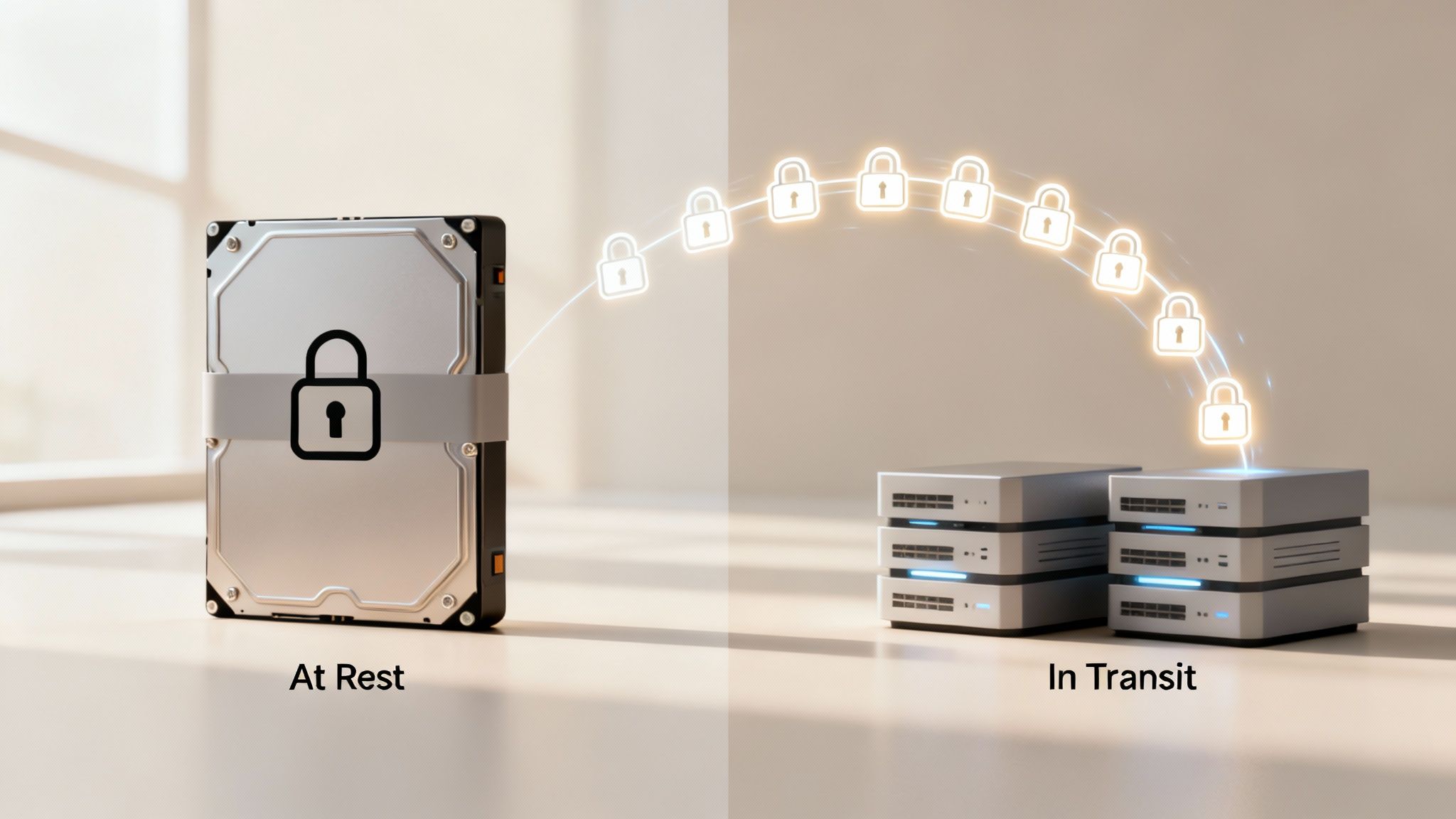
To achieve comprehensive data protection, encryption must be applied throughout the entire data lifecycle. This dual-layered approach involves securing data when it is stored on physical or virtual media (at rest) and protecting it as it moves across networks (in transit). Implementing both is a cornerstone of modern data encryption best practices, as it closes critical security gaps that attackers could otherwise exploit.
Applying encryption to data at rest protects sensitive information stored in databases, on servers, in cloud storage, and on endpoint devices like laptops. Meanwhile, encrypting data in transit safeguards it from eavesdropping or man-in-the-middle attacks as it travels between a user's device and a server or between different services. Neglecting either state leaves your data vulnerable.
Why It's a Top Priority
Failing to encrypt data in both states creates significant risks. An attacker who gains physical access to a hard drive or breaches a cloud storage bucket can easily steal unencrypted data at rest. Similarly, data sent over an unsecured network can be intercepted and read without in-transit encryption. Regulations like HIPAA and PCI DSS explicitly mandate encryption for both states, making it a non-negotiable requirement for compliance. For growing businesses, understanding these foundational security measures is crucial; explore more on the importance of cybersecurity for businesses.
Practical Implementation Steps
Follow these actionable guidelines to secure data comprehensively across its lifecycle:
- Enable Full-Disk Encryption: Use native tools like BitLocker (Windows), FileVault 2 (macOS), and LUKS (Linux) to encrypt entire hard drives on all endpoints and servers.
- Use TLS 1.3 for All Communications: Mandate the use of Transport Layer Security (TLS) version 1.3 (or at least 1.2) for all web traffic, API calls, and internal network communications to protect data in transit.
- Activate Database Encryption: Implement Transparent Data Encryption (TDE) for databases like Microsoft SQL Server and Oracle, which encrypts the data files without requiring application changes.
- Secure Cloud Storage: Configure server-side encryption (SSE) on cloud storage services like Amazon S3 and Azure Blob Storage to ensure data uploaded is automatically encrypted.
- Encrypt Backups: Ensure all backup data, whether stored on-site or in the cloud, is encrypted. A compromised backup can expose all of your most critical information.
7. Use Secure Key Exchange Protocols
Even the strongest encryption algorithm is useless if the keys used to encrypt and decrypt data fall into the wrong hands. Secure key exchange protocols are the cryptographic handshakes that allow two parties to safely establish a shared secret key over an insecure network, like the internet. This process is fundamental to securing data in transit, ensuring that an eavesdropper cannot intercept the key and decipher the entire conversation.
These protocols, pioneered by cryptographers like Whitfield Diffie and Martin Hellman, solve the critical problem of key distribution. They allow systems to generate a temporary, shared session key without ever sending the key itself across the channel. This mechanism is the backbone of modern secure communications, preventing man-in-the-middle (MitM) attacks where an attacker secretly relays and possibly alters the communication between two parties who believe they are directly communicating with each other. A robust key exchange is a non-negotiable component of any data encryption best practices framework.
Why It's a Top Priority
Failing to use a secure key exchange method leaves all encrypted communications vulnerable. An attacker could capture the key establishment process and compute the same session key, decrypting all subsequent traffic. This is particularly dangerous for sensitive data transmissions like financial transactions, patient health information (PHI) under HIPAA, or confidential client communications. Modern protocols like Transport Layer Security (TLS) 1.3 mandate secure key exchange methods to protect against these exact scenarios, making it a standard for secure web browsing and API communication.
Practical Implementation Steps
Follow these actionable guidelines to ensure your key exchange methods are secure and resilient:
- Prioritize Ephemeral Key Exchange: Use protocols that provide "forward secrecy" like Ephemeral Elliptic Curve Diffie-Hellman (ECDHE). This ensures that even if a server's long-term private key is compromised, past session keys cannot be calculated, protecting historical communications.
- Select Strong Curves and Parameters: For ECDHE, standardize on widely-vetted, high-performance curves like Curve25519 or P-256. These provide a high level of security with excellent performance.
- Authenticate the Exchange: Combine the key exchange with digital signatures (e.g., RSA or ECDSA) to authenticate the parties involved. This verifies you are exchanging keys with the intended server and not an imposter.
- Update and Configure Protocols Correctly: Ensure your servers are configured to use modern, secure protocols like TLS 1.3, which has removed support for outdated and insecure key exchange methods. Regularly update your cryptographic libraries to benefit from the latest security improvements.
8. Implement Encryption Key Derivation Functions (KDF)
One of the most common weak points in an encryption system is not the algorithm but the key itself, especially when it is derived from a user-generated password. Key Derivation Functions (KDFs) are specialized algorithms designed to transform a relatively weak input, like a password, into a strong, cryptographically secure encryption key. They intentionally add computational cost and randomization (salting) to make the resulting key resilient to brute-force and dictionary attacks.
Using a simple hashing function like SHA-256 to turn a password into a key is a critical mistake. These functions are designed for speed, which allows an attacker to test billions of password guesses per second. A proper KDF, such as Argon2 or PBKDF2, introduces "work factors" like memory usage or iteration counts, slowing down the process exponentially for an attacker while remaining fast enough for legitimate users. This is a vital component of modern data encryption best practices.
Why It's a Top Priority
Without a KDF, a strong encryption algorithm like AES-256 can be completely undermined by a weak, guessable password. KDFs act as a crucial security layer that mitigates the risk posed by human-memorable (and often insecure) passwords. For any system where users set their own passwords to protect encrypted data, such as password managers or encrypted user profiles, implementing a modern KDF is non-negotiable for ensuring data confidentiality and integrity. Password managers like Bitwarden and 1Password rely heavily on strong KDFs to protect user vaults.
Practical Implementation Steps
Follow these actionable guidelines to properly leverage KDFs in your security architecture:
- Select a Modern KDF: For new applications, standardize on Argon2id. It is the winner of the Password Hashing Competition and offers resistance to a wider range of attacks than older alternatives.
- Use Unique, Large Salts: Always use a unique, randomly generated salt for every password. The salt should be at least 128 bits (16 bytes) to prevent an attacker from building pre-computed rainbow tables.
- Configure High Work Factors: Tune the computational cost to be as high as your system can tolerate without negatively impacting user experience. For PBKDF2, this means a high iteration count (e.g., 310,000+); for Argon2, adjust memory, parallelism, and time cost parameters.
- Benchmark Performance: Test your chosen KDF configuration on your target hardware to find the right balance between security and performance before deploying to production.
9. Secure Encryption Implementation Against Side Channels
Even with a strong algorithm, the way encryption is implemented can create subtle vulnerabilities. Side-channel attacks don't break the mathematical foundation of encryption; instead, they exploit information leaked from the physical implementation of a system, such as timing variations, power consumption, or electromagnetic emissions, to extract secret keys. Securing against these attacks is a crucial step in a defense-in-depth security strategy.
Pioneering work by cryptographers like Paul Kocher highlighted how an attacker can measure the time it takes for a system to perform cryptographic operations and deduce secret key bits. Similarly, cache-timing attacks, researched by Dan Boneh and David Brumley, exploit how data is accessed in a processor's cache. Protecting against these threats requires specialized coding practices and, in some cases, dedicated hardware designed for cryptographic operations. This is a vital component of modern data encryption best practices.
Why It's a Top Priority
A standard, functionally correct encryption implementation can inadvertently leak secrets. For example, if a key comparison operation exits early as soon as it finds a mismatch, the total execution time reveals information about the key itself. Attackers can leverage these minute differences to reconstruct cryptographic keys, completely bypassing the algorithm's strength. For organizations handling highly sensitive data subject to regulations like HIPAA or PCI-DSS, failing to mitigate side channels can lead to a catastrophic breach and severe compliance penalties.
Practical Implementation Steps
Follow these guidelines to harden your cryptographic implementations against side-channel leakage:
- Use Side-Channel Resistant Libraries: Never implement your own crypto. Instead, use libraries explicitly designed with side-channel resistance in mind, such as libsodium, which uses constant-time algorithms to prevent timing leaks.
- Leverage Hardware-Based Security: Utilize Trusted Execution Environments (TEEs) like Intel SGX or ARM TrustZone to isolate cryptographic operations from the rest of the system, creating a secure enclave.
- Enable Hardware Acceleration: Modern CPUs include instruction sets like AES-NI that are not only faster but are also implemented in hardware to be resistant to many common cache-timing attacks.
- Write Constant-Time Code: When custom cryptographic logic is unavoidable, ensure all operations involving secret data take a fixed amount of time, regardless of the data's value. Avoid data-dependent branches and memory lookups.
- Consider Hardware Security Modules (HSMs): For the highest level of assurance, perform all cryptographic key management and operations within a dedicated, tamper-resistant HSM device.
10. Establish Encryption Monitoring and Audit Procedures
Implementing strong encryption is only half the battle; continuously verifying its effectiveness is the other. Establishing comprehensive monitoring and auditing procedures provides the necessary oversight to ensure your encryption controls are working as intended. This involves actively logging, tracking, and reviewing all encryption-related activities to detect anomalies, policy violations, and potential security incidents in real-time.
A robust monitoring strategy acts as a security camera for your entire encryption infrastructure. It captures every significant event, from a key being used to decrypt a database to a failed access attempt on a key vault. This granular visibility is not just a data encryption best practice; it's a non-negotiable requirement for compliance frameworks like PCI-DSS and HIPAA, which mandate auditable trails of access to sensitive data and cryptographic keys.
Why It's a Top Priority
Without monitoring, your encryption system is a black box. You cannot detect if a key has been compromised, if an unauthorized user is attempting to access encrypted data, or if a misconfiguration is leaving sensitive information exposed. Proactive monitoring and auditing transform encryption from a static defense into a dynamic one, enabling your security team to respond to threats before they escalate into a full-blown data breach. For organizations handling regulated data, these audit logs are crucial evidence of due diligence during a security assessment.
Practical Implementation Steps
Follow these actionable guidelines to build a resilient monitoring and auditing program for your encryption systems:
- Centralize All Encryption Logs: Aggregate logs from all sources, including cloud key management services (AWS KMS, Azure Key Vault), hardware security modules (HSMs), and application-level encryption activities, into a central SIEM platform like Splunk or an ELK Stack.
- Configure High-Priority Alerts: Set up automated alerts for suspicious events such as unusually high numbers of decryption failures, access to keys outside of business hours, or key usage from unauthorized geographic locations.
- Protect the Audit Logs: The integrity of your audit logs is paramount. Secure them with strict access controls and consider encrypting the logs themselves to prevent tampering or unauthorized deletion.
- Automate Compliance Reporting: Leverage your logging platform to automatically generate reports required for compliance audits (e.g., PCI-DSS, HIPAA), demonstrating who accessed what encrypted data and when. For complex environments, engaging professional security services can ensure your monitoring meets stringent regulatory demands. You can discover managed cybersecurity solutions that help implement and manage these critical procedures.
10-Point Comparison of Data Encryption Best Practices
| Practice | 🔄 Implementation Complexity | ⚡ Resource Requirements | ⭐ Expected Outcomes | 📊 Ideal Use Cases | 💡 Key Advantages / Tips |
|---|---|---|---|---|---|
| Use Strong Encryption Algorithms | Moderate — integrate vetted libs, avoid custom crypto | Moderate — CPU cost, library support | Very high ⭐⭐⭐⭐ — proven cryptographic strength | Protecting sensitive data at rest/in transit, protocol crypto | Use OpenSSL/libsodium/BouncyCastle; keep libs patched |
| Implement End-to-End Encryption | High — client-side crypto, key handling & UX changes | High — client CPU, complex backup/recovery | Very high ⭐⭐⭐⭐⭐ — prevents provider/intermediary access | Messaging, private email, zero-knowledge cloud storage | Use Signal/Noise protocols; provide clear UX for keys |
| Enforce Proper Key Management Practices | High — lifecycle processes, policies, HSM/KMS integration | High — HSMs/KMS, staffing, training | Very high ⭐⭐⭐⭐ — minimizes impact of key compromise | Enterprise, regulated environments, cloud key management | Use dedicated KMS/HSM, automate rotation, never hardcode keys |
| Use Authenticated Encryption with Associated Data (AEAD) | Moderate — adopt AEAD modes, careful nonce use | Moderate — small crypto and RNG overhead | Very high ⭐⭐⭐⭐ — confidentiality + integrity in one step | TLS, VPNs, secure messaging, authenticated payloads | Never reuse nonces; verify tags before processing |
| Implement Perfect Forward Secrecy (PFS) | Moderate — ephemeral key generation per session | Moderate–High — extra key-exchange CPU | High ⭐⭐⭐⭐ — protects past sessions if long-term keys leak | TLS, messaging, VPNs where recorded traffic protection is needed | Prefer ECDHE (Curve25519); ensure server/client support |
| Encrypt Data at Rest and in Transit | Moderate–High — deploy across storage, DBs, network | High — I/O overhead, TLS termination, key mgmt | High ⭐⭐⭐⭐ — broad protection across data lifecycle | Enterprises, cloud deployments, compliance-driven systems | Enable TDE, TLS1.2+/1.3, encrypt backups and archives |
| Use Secure Key Exchange Protocols | Moderate — choose curves/protocols, add authentication | Moderate — CPU for ECDH/Curve25519, entropy sources | High ⭐⭐⭐⭐ — secure session key establishment | TLS, SSH, VPNs, protocol design requiring secure key agreement | Prefer Curve25519/X25519; combine with signatures for auth |
| Implement Encryption Key Derivation Functions (KDF) | Low–Moderate — library use + parameter tuning | Configurable — can be CPU/memory intensive (Argon2) | High ⭐⭐⭐⭐ — resists brute-force on weak inputs | Password hashing, deriving keys from passwords or seeds | Use Argon2id/HKDF, unique salts, benchmark parameters |
| Secure Encryption Implementation Against Side Channels | High — constant-time code, hardware mitigations | Moderate–High — expert devs, specialized hardware | High ⭐⭐⭐⭐ — defends against physical/timing attacks | HSMs, secure enclaves, high-value cryptographic systems | Use libs designed for constant-time, avoid secret-dependent branches |
| Establish Encryption Monitoring and Audit Procedures | Moderate–High — centralize logs, integrate SIEM/SOC | High — log storage, analytics, secure retention | High ⭐⭐⭐⭐ — improves detection and compliance evidence | Compliance environments, SOC operations, regulated industries | Centralize logs, alert anomalies, encrypt and protect audit trails |
From Theory to Action: Securing Your Data with Expert Guidance
Navigating the landscape of data encryption can feel like learning a new language, one filled with complex algorithms, cryptographic protocols, and ever-shifting compliance mandates. Throughout this guide, we've broken down the essential components of a powerful encryption strategy, moving from foundational concepts to advanced, practical applications. You now have a clear roadmap covering the most critical data encryption best practices for securing your sensitive information.
We’ve explored the non-negotiable need for strong, modern algorithms like AES-256 and the critical role that proper key management plays in preventing catastrophic data breaches. We have also distinguished between the separate but equally vital protections for data at rest and data in transit, and highlighted advanced techniques like Perfect Forward Secrecy (PFS) and Authenticated Encryption with Associated Data (AEAD) that provide layered, future-proof security. The core takeaway is clear: encryption is not a single product you buy, but a multifaceted process you must actively manage.
Your Path Forward: From Knowledge to Implementation
The journey from understanding these principles to implementing them effectively requires diligence and precision. The difference between a secure system and a vulnerable one often lies in the small details of configuration and maintenance. As you move forward, focus on these key pillars:
- Holistic Implementation: Remember that encryption is just one, albeit critical, layer of your security. It must be integrated with access controls, network security, and regular vulnerability assessments. For a holistic approach to protecting your digital assets and ensuring resilience, consider delving into comprehensive cyber security risk management strategies to build a defense that is truly layered.
- Continuous Vigilance: The cryptographic world does not stand still. New threats emerge, and older algorithms are eventually deprecated. A commitment to regular audits, monitoring, and updating your encryption protocols is not optional; it is a fundamental requirement for long-term data security.
- Compliance as a Standard: For organizations in San Antonio and beyond dealing with HIPAA, PCI DSS, or CMMC requirements, these best practices are not just suggestions but mandates. Treating compliance as a baseline for your security efforts, rather than a final goal, will ensure you not only meet regulatory standards but genuinely protect your stakeholders' data.
Implementing robust encryption is an investment in trust, resilience, and business continuity. It reassures your clients, protects your intellectual property, and fortifies your reputation against the constant threat of cyber attacks. While the technical details can seem daunting, the principles are straightforward: protect your data everywhere, manage your keys meticulously, and never stop validating your defenses. By embracing these data encryption best practices, you are building more than a secure network; you are building a resilient and trustworthy organization poised for future success.
Ready to translate these best practices into a powerful, managed security reality for your business? The experts at Defend IT Services specialize in designing, implementing, and managing robust encryption and cybersecurity solutions tailored to the unique compliance and operational needs of businesses in San Antonio. Let us handle the complexities of cryptographic security so you can focus on what you do best.