
Cybersecurity services for small businesses are the protective layers that keep your company's data, networks, and devices safe from digital threats. For most small businesses, this means bringing in an outside partner for things like 24/7 threat monitoring, endpoint security, and reliable data backup to fend off attacks that could otherwise be devastating.
Why Your Small Business Is a Prime Target for Hackers
Let's get one thing straight: if you think your business is too small to be a target, you're putting it at risk. Cybercriminals don't just go after the big guys. They actively hunt for small and medium-sized businesses precisely because you have valuable data but often lack the Fort Knox-level defenses of a large corporation.
They don't see you as a small fish; they see you as an easy meal.

This isn't about scare tactics. It's about being realistic so you can make smart decisions to protect the business you've worked so hard to build.
The Modern Threat Landscape
The reality is that attackers almost always take the path of least resistance. Automated bots are constantly sweeping the internet for weaknesses, and a small business running outdated software or using simple passwords is a goldmine. Just one breach can have catastrophic consequences.
Here are a few common scenarios I see all the time:
- Ransomware: Your most important files—client lists, financial records, you name it—are locked up and held hostage. The only way to get them back? A massive payout.
- Phishing Scams: A cleverly disguised email tricks an employee into giving up their login info. Suddenly, an attacker has the keys to your kingdom, whether it's your bank account or your entire customer database.
- Business Email Compromise (BEC): A criminal poses as the CEO or a trusted vendor and tricks your finance person into making a wire transfer. Thousands of dollars can vanish in an instant.
The Sobering Statistics
The numbers don't lie. An alarming 43% of all cyberattacks are aimed squarely at small businesses. The fallout is often fatal—60% of small companies that suffer a major cyberattack go out of business within six months. This stark reality underscores https://defenditservices.com/the-importance-of-cybersecurity-for-growing-businesses/.
The belief that "we're too small to be a target" is the single most dangerous assumption a small business owner can make. Attackers don't care how big you are; they only care about how vulnerable you are.
Getting a handle on these threats means understanding the different ways attackers can get in. For instance, learning how to prevent Man-in-the-Middle (MITM) attacks is a practical step toward building a stronger defense. Ignoring this reality is like leaving your front door wide open for financial loss, reputational ruin, and even the end of your business.
How to Pinpoint Your Biggest Security Gaps
Before you even start looking at security providers, you need a clear map of what you're actually protecting. Figuring out where you're vulnerable doesn't require a PhD in computer science; it really just boils down to asking some focused questions about how your business runs day-to-day.
The goal here isn't to become a security expert overnight. It's to build a smart, prioritized list of your biggest risks. That way, when you do talk to a potential security partner, you can have a productive, specific conversation instead of just saying, "we need help."
This whole process starts with identifying your most critical digital assets. Just think: what information, if it got stolen, lost, or leaked online, would do the most damage to your business?
Start with Your Crown Jewels
Every single business has them. We're not just talking about random files, but the absolute lifeblood of your company. Your first job is to simply list them out.
- Customer Data: This is the big one. We're talking names, email addresses, phone numbers, and especially any payment information you might store.
- Financial Records: Think about your accounting files, bank account details, payroll information, and all those sensitive tax documents.
- Proprietary Information: This is your secret sauce. It could be your unique business processes, client contracts, a secret recipe, or crucial design schematics.
Once you know what you need to protect, the next step is to figure out where it all lives. Is your customer list sitting in a cloud CRM like Salesforce? Are your financials on a local server tucked away in the office? Just mapping this out begins to show you how data moves through your business—and where it might be exposed.
Identify Common Weak Points
With your asset map in hand, you can start looking for the common, unlocked doors that attackers absolutely love to find. You'd be surprised how many small businesses leave the exact same vulnerabilities wide open without even realizing it.
Inconsistent software updates, for example, are a massive problem. When you and your team keep hitting "remind me tomorrow" on those update notifications, you're basically leaving a known flaw open for anyone to exploit. Another classic entry point? Weak or reused passwords. If your employees are using "Password123" or their dog's name for multiple accounts, a breach in one unrelated system can suddenly give an attacker the keys to your kingdom.
A self-assessment isn't about finding every single flaw. It's about developing a clear understanding of your risk profile, so you can have an intelligent, productive conversation about cybersecurity services for small businesses.
The tough reality is that most business owners are flying blind. It's shocking, but one-third of small businesses with 50 or fewer employees are just using free, consumer-grade security tools. Worse, one in five use no endpoint protection whatsoever.
And it gets more concerning. An astonishing 74% of small business owners either try to manage cybersecurity themselves or hand it off to family members with no formal training. You can dig into more of these stats in this small business cybersecurity report.
Finally, don't forget to think about your people. A lack of regular employee training on how to spot a phishing email is one of the biggest and most common security gaps out there. Your team can either be your strongest line of defense or your most significant vulnerability.
What Cybersecurity Services Do You Actually Need?
Let's be honest, the cybersecurity world loves its acronyms. MSSP, EDR, SIEM—it's enough to make your head spin when all you want to do is keep your business safe. The good news is you don't need to be a security guru to make smart decisions. It's about cutting through the jargon to find practical solutions for the real risks your business faces.
The key is to match the right service to the specific weaknesses you’ve already uncovered. This isn't about buying a bit of everything; it's a strategic move. You're investing in a shield that’s custom-fit to your vulnerabilities.
The process boils down to a simple, logical flow that we security pros use all the time: figure out what you need to protect, see who can get to it, and then plug the holes.
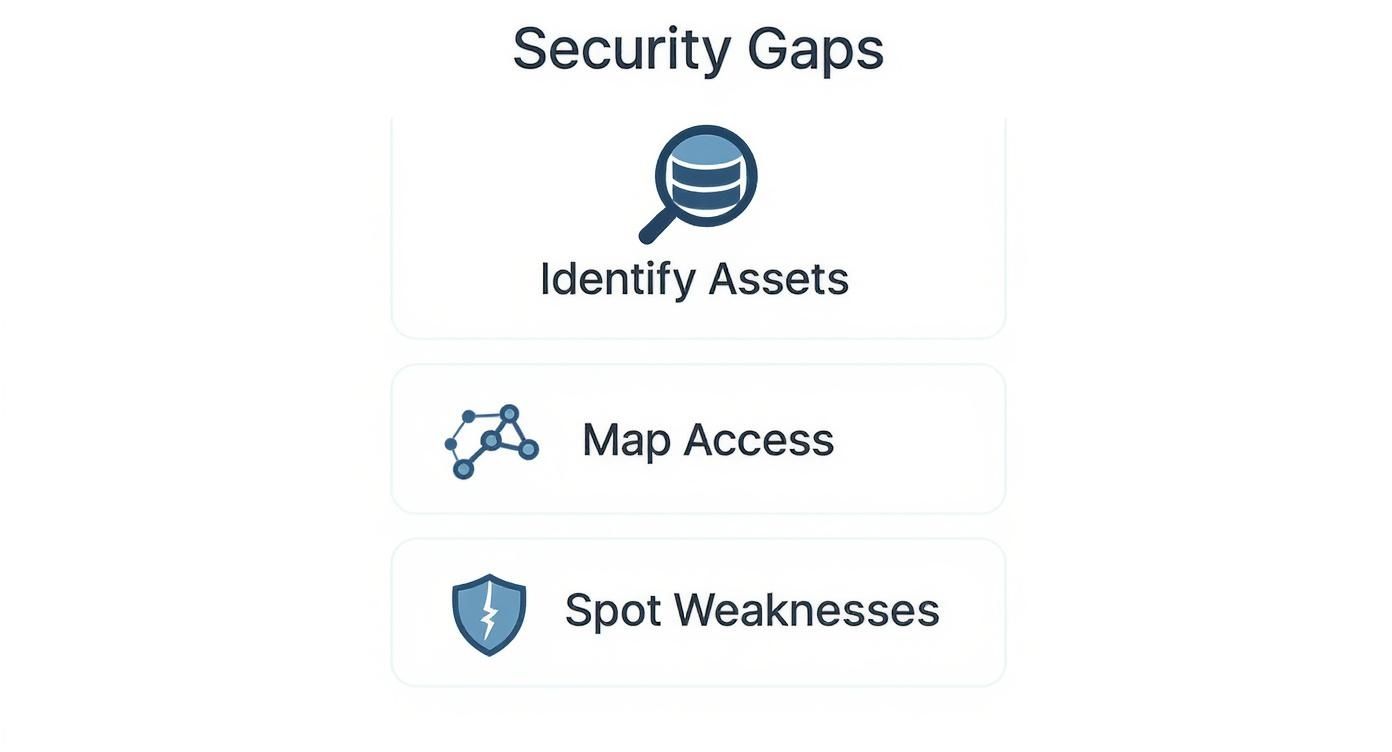
With that framework in mind, let’s look at the services that will likely form the foundation of your defense.
Do I Need a Managed Security Service Provider (MSSP)?
Think of a Managed Security Service Provider (MSSP) as your on-demand, expert security department. Instead of the massive expense of hiring an in-house team, an MSSP gives you 24/7 monitoring, management, and threat response using their own high-end tools and seasoned analysts.
This is why it's one of the most popular cybersecurity services for small businesses—it delivers enterprise-level protection without the enterprise-level price tag. They handle the daily grind of watching network traffic, managing firewalls, and chasing down alerts, freeing you up to actually run your business.
What Is Endpoint Detection and Response (EDR)?
Every laptop, server, and computer in your company is an "endpoint," and they are prime targets for cyberattacks. Endpoint Detection and Response (EDR) is the next-generation replacement for traditional antivirus.
Your old antivirus program works like a bouncer with a list of known troublemakers. EDR, on the other hand, is like a security guard inside the building, actively watching for any suspicious behavior to stop brand-new threats—like ransomware—before they can do any real damage.
Here's a classic scenario: an employee gets a clever phishing email and clicks a bad link. An EDR solution will spot the unusual commands being executed, instantly quarantine that machine from the network to stop the attack from spreading, and flag it for an expert to investigate.
For a small business, a single compromised endpoint can quickly lead to a full-blown network breach. EDR provides the critical visibility and rapid response needed to contain threats at the source, making it an essential layer of modern defense.
Protecting Your Network and Cloud Data
Your network is the nervous system of your business, and cloud platforms like Microsoft 365 or Google Workspace are where your most valuable data now lives. Leaving either of them unprotected is simply not an option.
Network Security: This covers everything from managed firewalls and intrusion detection systems to ensuring your Wi-Fi is locked down tight. It’s all about creating a strong perimeter to block malicious traffic from ever reaching your devices.
Cloud Security: As work shifts to the cloud, so does the risk. This service focuses on configuring your cloud apps securely, watching for unauthorized logins, and preventing sensitive data from being accidentally exposed to the public.
To help you visualize how these services fit together, here’s a quick breakdown of the most common options.
Essential Cybersecurity Services for Small Businesses
| Service Category | What It Does | Best For Businesses That… |
|---|---|---|
| Managed Security (MSSP) | Provides outsourced 24/7 security monitoring, threat detection, and incident response. | Lack a dedicated in-house security team and need expert oversight without the high cost. |
| Endpoint Security (EDR) | Actively monitors computers and servers to detect and stop advanced threats like ransomware in real-time. | Have employees who might click on phishing links or download malicious files. (So, everyone). |
| Network Security | Manages firewalls and monitors network traffic to block unauthorized access and malicious activity. | Operate from a physical office or have a central network connecting their devices. |
| Cloud Security | Secures data and applications in cloud environments (e.g., Microsoft 365, AWS) to prevent data breaches. | Rely heavily on cloud-based tools for daily operations and data storage. |
| Vulnerability Assessments | Proactively scans systems and networks to find and prioritize security weaknesses before attackers can. | Want to understand their specific risks and create a targeted plan to fix them. |
| Data Backup & Recovery | Creates secure, isolated copies of your critical data so you can restore it after a disaster or ransomware attack. | Cannot afford to lose access to their financial records, customer data, or operational files. |
Ultimately, these individual services are just the building blocks. The real strength comes from developing a robust cybersecurity strategy that makes them all work together as a cohesive defense.
Finding the Right Cybersecurity Partner for Your Business
Picking a cybersecurity provider is a huge decision. You’re not just buying a service; you’re bringing in a partner and trusting them with the keys to your entire digital operation. It's so important to look past the shiny sales deck and get into the nitty-gritty of what they can actually do for you.
A great partner should feel like a natural extension of your team, someone who is just as committed to protecting your business as you are.
Vetting Potential Providers with the Right Questions
Before you even think about signing a contract, you need to interview potential providers. Their answers will tell you everything you need to know about their experience, their technical chops, and whether they're the right fit for your company. Don't hold back—your security is on the line.
Here are a few essential questions to get the conversation started:
- Experience: "Can you show me a few case studies or examples of how you’ve helped businesses my size and in my industry?" A provider who already knows the specific threats and compliance rules for your sector is a massive advantage.
- Incident Response: "Walk me through your exact process when a client has a security breach. Who do I call, and what should I expect in that first critical hour?" Look for a clear, confident, and systematic answer. Anything less is a warning sign.
- Reporting and Communication: "What do your reports look like, and how often will I get them? How will you let me know about critical threats versus just routine updates?" You need a partner who gives you actionable insights, not just a stream of technical jargon.
These kinds of questions help you figure out if their approach actually matches what you need. Understanding why every San Antonio business needs managed IT and cybersecurity services can also give you context for the kind of local, hands-on support you might be looking for.
If a potential partner gets vague or hesitates when you ask these questions, consider it a major red flag. Real experts are ready for this level of scrutiny and should be eager to prove their worth.
Decoding SLAs and Pricing Models
Once you've narrowed down your list, it's time to dig into the fine print: the Service Level Agreements (SLAs) and their pricing. An SLA isn't just a formality; it’s a contract that sets clear expectations for service, especially how fast they’ll jump into action during a crisis.
Look for specific, guaranteed response times for critical incidents. Vague promises like "a prompt response" mean nothing. You need hard numbers, like a guaranteed one-hour response for a major security event.
Figuring out the cost is just as critical. While 63% of small businesses are increasing their cybersecurity budgets, 66% also say cost is their biggest roadblock. This financial pressure means you need a pricing model that's transparent and can grow with you. You can find more details on these small business cybersecurity statistics over on the Heimdal Security blog.
You’ll typically see a few common pricing models:
- Per-Device: A flat monthly fee for each computer, server, or phone you want to protect.
- Per-User: A fee for each employee, which often works better if your team uses multiple devices.
- Tiered Packages: Bundled services at different price points, letting you pick a plan that fits your risk level and budget.
Make sure you ask about hidden fees. Are you going to get a surprise bill for after-hours support or emergency help? A trustworthy partner will lay out all the potential costs from the start, so you can choose a plan that gives you real protection without any nasty financial surprises.
What to Expect During Onboarding and Deployment
You’ve signed the contract and picked your cybersecurity partner. Great! But now for the important part: getting everything set up. A smooth, well-managed deployment is what turns that signed agreement into actual, real-world protection for your business.
Knowing what to expect can make all the difference, helping you manage the transition without pulling your hair out or disrupting your team's work.
It all kicks off with a welcome call. This isn't just a simple "hello"—it's a critical strategy session. You, your key people, and the provider's deployment team will get on the same page, nail down a timeline, and figure out exactly how you'll communicate.
From there, it’s all about technical discovery. Your new provider needs to get under the hood of your business to understand your environment inside and out. Think of it as a deep dive, where they map out your entire digital footprint.
The Initial Technical Setup
This is where your provider starts putting the digital shields up. It's a hands-on, collaborative process, and they’ll need your help to get the access they need to do their job.
Here’s what usually happens first:
- Network and System Scans: The team will run scans to map your entire network, find every single device connected to it, and flag any glaring, high-risk vulnerabilities. This initial sweep confirms the scope of work and, more often than not, uncovers a forgotten server or some "shadow IT" someone set up years ago.
- Agent Deployment: Next, they'll install security software—usually called an "agent"—on every computer and server. This little piece of code is the magic behind the 24/7 monitoring and threat detection you’re paying for.
- Credential and Access Provisioning: This part is built on trust. You’ll need to grant them secure, admin-level access to your critical systems, cloud accounts, and network hardware. It’s absolutely essential for them to manage and protect your assets effectively.
Your active participation during onboarding is non-negotiable. A provider can have the best tools in the world, but if they can't get the access they need, your business remains exposed. A transparent and cooperative process is the foundation of a successful partnership.
Your Role in a Successful Rollout
While your new partner is handling the technical heavy lifting, your role is just as critical. A successful rollout of cybersecurity services for small businesses hinges on your internal support and clear communication.
You need to be the champion for these new security measures within your company. That means explaining to your team why these changes are happening and what to expect. You might need to schedule a bit of downtime for software installations or network tweaks, and it's your job to make sure everyone is prepared.
This is also the perfect time to launch employee security training. Many providers offer resources or can even lead a session on how to spot phishing emails and practice good security hygiene. When you get your team on board from day one, you turn them from a potential weak link into your first line of defense.
Answering Your Top Cybersecurity Questions
Jumping into professional cybersecurity brings up a ton of questions. It's a big step, and you're right to want all the details before you commit. Let's walk through some of the most common things I hear from small business owners and get you some clear, straightforward answers.
How Much Should We Really Be Budgeting for This?
This is the big one, isn't it? Everyone wants a magic number, but the truth is, it varies. Your costs will depend on your size, what industry you're in, and exactly what kind of protection you need.
A good starting point is to think about dedicating somewhere between 5% and 20% of your overall IT budget specifically to security. For a lot of small businesses, that might mean a few hundred dollars a month; for others, it could be a few thousand.
Instead of just focusing on the monthly bill, think about it as an investment in risk reduction. A single data breach can cost a small business tens or even hundreds of thousands of dollars. Suddenly, that proactive security cost looks a lot more reasonable. The best way forward is to get quotes from a few different providers to see what the market rate is for the services you need.
Can't We Just Handle This In-House?
You could, but I almost always advise against it unless you have a trained, dedicated security expert on your payroll. And I don't mean your go-to IT person who handles everything else. Cybersecurity is a full-time job. The threats change every single day.
Keeping up requires constant monitoring, staying on top of every software patch, and analyzing threat data. That’s just not realistic for a business owner or a general IT support person to handle on top of their other duties. Relying on basic, consumer-grade tools and a non-specialist often leads to a false sense of security, which can be even more dangerous than having no security at all.
Partnering with a professional service means you get to focus on what you do best—running your business—while genuine experts keep watch. You get access to sophisticated tools and 24/7 monitoring that would be practically impossible for a small business to build on its own.
If We Can Only Afford One Thing, What Should It Be?
Great question. If you have to pick one place to start, make it Managed Endpoint Detection and Response (EDR). Hands down, it's the most critical service.
Why? Because the most common way hackers get in is through your employees' devices—their laptops, desktops, and even servers. We call these "endpoints." Old-school antivirus just doesn't cut it anymore.
EDR is different. It provides advanced threat detection, constantly watches for suspicious activity, and can quickly shut down and isolate a threat before it spreads. Think of it as an around-the-clock security guard for every single device your company uses. In an age of remote work, that's not just a nice-to-have; it's essential. This single service tackles your biggest vulnerability and gives you the strongest foundation to build on.
Ready to stop worrying about the "what ifs" and start building a real defense? The team at Defend IT Services specializes in creating security roadmaps that fit the unique needs and budgets of small businesses. Get the expert protection you need to grow safely. Learn more about our cybersecurity solutions.